


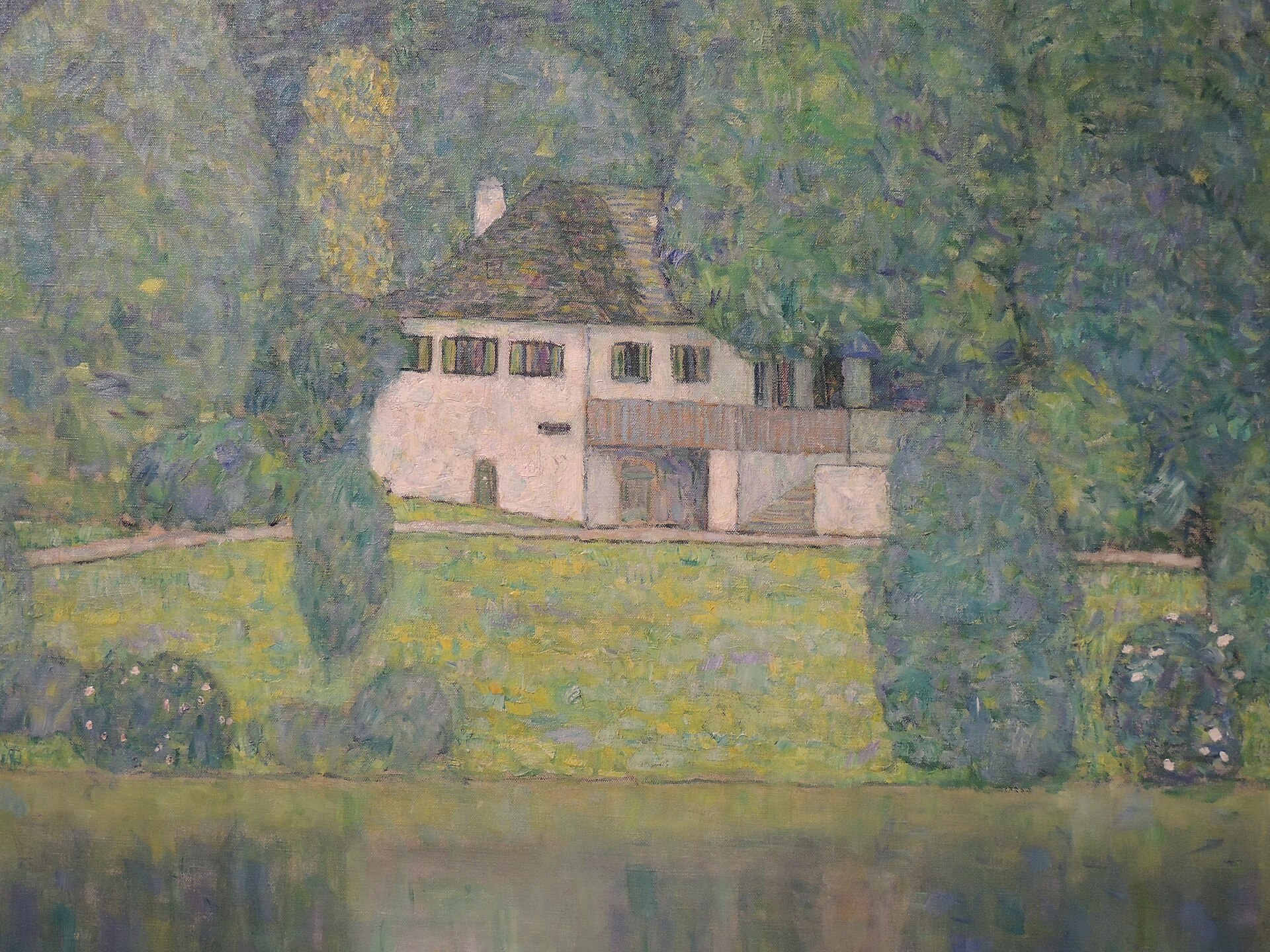
On Tuesday night at Christie’s in New York, a square landscape of an Austrian lake will go under the hammer with an estimate of $60 million to $80 million. Gustav Klimt’s Litzlbergkeller (1915–16) is one of the most important of his Attersee paintings still in private hands, and its sale is one of the most closely watched moments of the New York auction week.
Here is what the painting is, how Klimt made it, and why it could command such a price.
Summers on the Attersee
For most of the last two decades of his life, Klimt spent his summers at the Attersee, a large lake in the Salzkammergut region of Upper Austria. He went there with Emilie Flöge and her family, and the lake became the subject of almost all of his landscapes. Away from the gold and the portrait commissions of Vienna, he painted water, orchards, villas and lakeside villages in a quieter, almost meditative register.
Litzlbergkeller shows the inn and brewery of that name on the lake’s northern shore, seen across the water. There are no people. The buildings sit in a band of trees between a shimmering lake and a sliver of sky, and the whole picture is built from small, dense touches of colour, closer to a mosaic or tapestry than to conventional landscape painting.
A telescope and a square canvas
Klimt’s landscapes are unusual in two ways. First, he almost always used a square canvas, which flattens the view and gives his lakes and hillsides a decorative, patterned quality. Litzlbergkeller measures 110.5 by 110.5 centimetres.
Second, he often looked at his subjects from a distance through a telescope or opera glasses, which compressed the scene and cut it free from the surrounding landscape. For this picture, he studied the view from the opposite shore and worked from postcards as well. He began it in the summer of 1915 and finished it in his Vienna studio in May 1916, two years before his death.
A collector’s painting
The work was commissioned by Otto Primavesi, the banker and industrialist who was one of Klimt’s most important patrons. It later passed through the hands of the Austrian photographer and ethnographer Hugo Bernatzik and the dealer and collector Serge Sabarsky, a co-founder of the Neue Galerie in New York. The current owners’ family bought it at the sale of Sabarsky’s estate in 1997, and the painting has since spent years on loan to the Leopold Museum in Vienna.
Why $60 million to $80 million?
Klimt’s market has never been stronger. Landscapes by him rarely appear at auction, because so many are in museums, and the ones that do have sold for very large sums. Last November a Klimt portrait sold at Sotheby’s for $236.4 million, and his lake views have consistently drawn heavy competition from collectors and private museums.
Litzlbergkeller combines all the things that drive those prices: a classic Attersee subject, a distinguished provenance with no gaps, a long museum loan, and almost three decades off the market. It is the joint top estimate of the week alongside Christie’s Kandinsky, and the Klimt is likely to be the lot that tells the trade how deep the market really is at the very top.
The painting is on public view at Christie’s, 20 Rockefeller Center, until the sale on November 17. For the other big lots that week, see our guide to New York’s November auctions.