

In the temples of China, the afterlife has long been a place of extraordinary cruelty. Scroll paintings of the Ten Courts of Hell show sinners boiled in cauldrons of oil, ground in stone mills and pounded in giant mortars, while demons and officials look on. They were made to frighten people into virtue.
Zhiyu You has borrowed that machinery and moved it into the kitchen. In her series Hell Scene Painting, the punishments are no longer handed down by the kings of the underworld. They take place on an induction hob, in a bamboo steamer, in a deep fryer and in a glass of melting ice, and the people being cooked are women and babies.
A Chinese-born illustrator in New York
You is a Chinese-born illustrator and visual artist based in New York. She earned her BFA in illustration from the School of Visual Arts in 2022, and her practice combines traditional painting techniques with digital drawing, producing a visual language shaped by her Chinese cultural background.
Her editorial and commercial clients include The New Republic, Zócalo Public Square, Shenzhen Press Group Publishing House and the tea brand Tbaar, whose Christmas cup sleeve art contest she won in 2022, taking the $5,000 grand prize. Her work has been recognised by Communication Arts, the Society of Illustrators, the London International Creative Competition, Creative Quarterly and 3×3, and she has exhibited at the Society of Illustrators and Bobblehaus in New York, and in group shows in the United States and China.
Across all of it runs one subject: the inner lives of women, and the feelings that sit beneath daily routines, familiar spaces and social expectations, which rarely get said out loud.
A hell made of housework
Hell Scene Painting reimagines traditional Chinese depictions of hell to look at contemporary domestic life, gender inequality and the expectations placed on women. The pictures are drawn on a warm, paper-coloured ground that recalls old scrolls, and each is crowded with tiny skeletal figures with oversized skulls, who do the work of the demons. They stoke fires, chop firewood, push wheelbarrows, sprinkle salt and stand on stepladders to stir the pot.
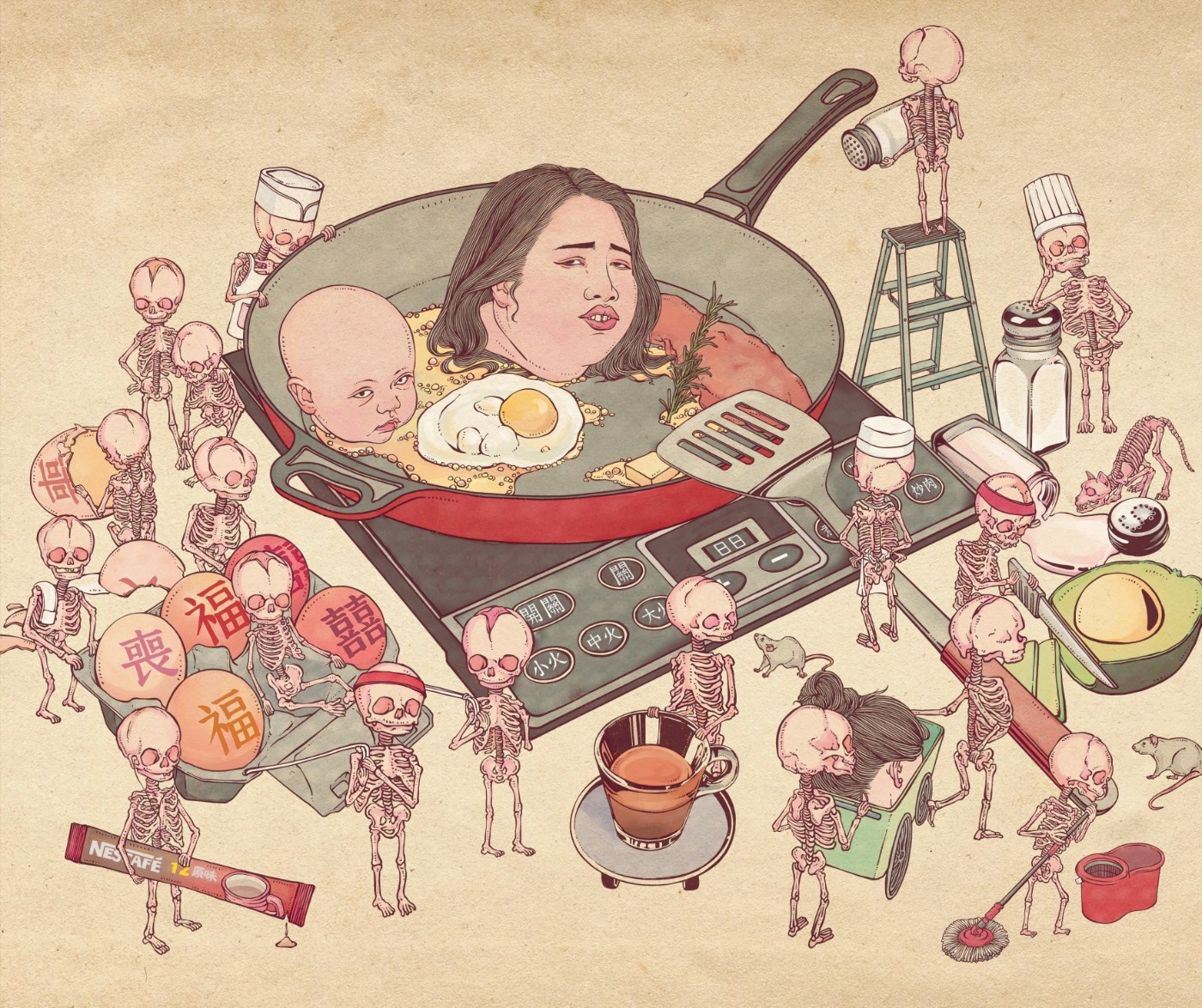
In Pan Hell, the image at the top of this page, a woman’s head and a baby’s head sit in a frying pan beside a fried egg, a sprig of rosemary and a pat of butter. The hob’s buttons are labelled in Chinese for low, medium and high heat. A carton of eggs nearby carries the characters for fortune, for double happiness, the sign used at weddings, and for mourning: the great events of a family’s life, laid out like groceries.
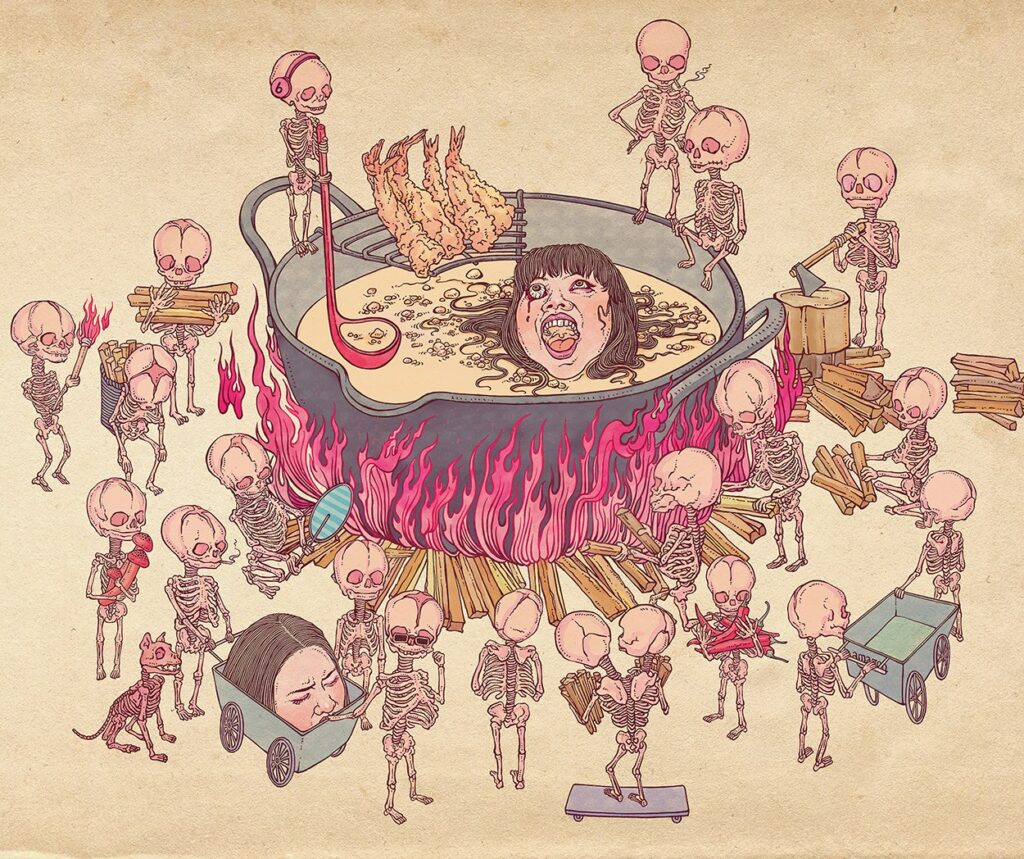
Deep Frying Pan Hell is the closest descendant of the old scrolls, where the cauldron of boiling oil is one of the best-known torments. Here the woman screams from the oil next to a batch of tempura prawns, while skeletons feed the fire and wheel away a second head in a cart.
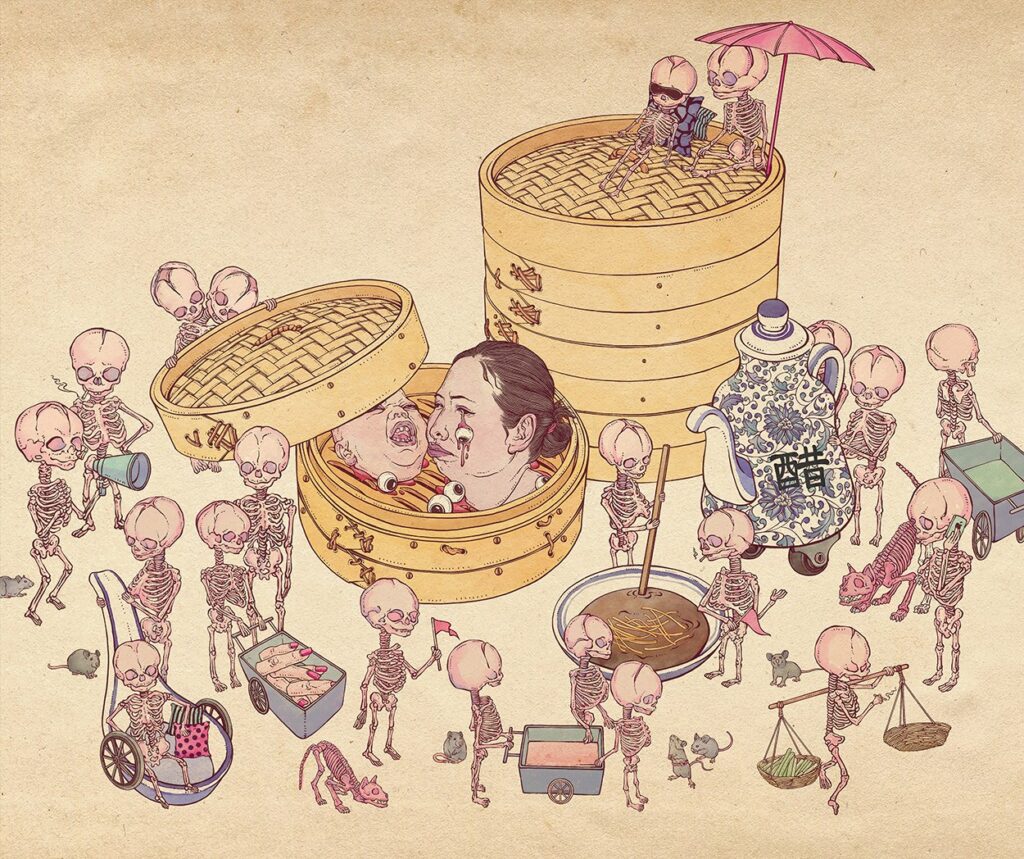
Steamer Hell is quieter and sadder. A mother and her crying baby are packed together in a dim sum steamer, tears running down her face. Beside them stands a blue-and-white porcelain jug marked with the character for vinegar. In Chinese, to “eat vinegar” means to be jealous, and the detail is typical of the way You hides language and wordplay in her compositions for those who can read them.
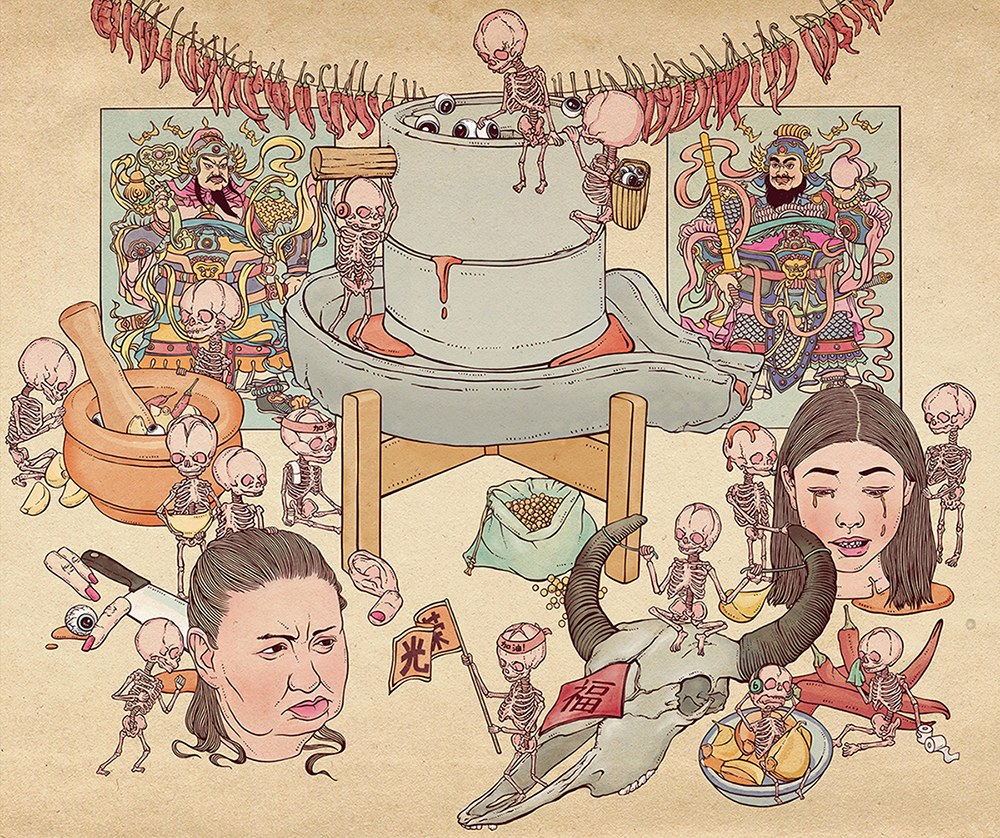
In Stone Mill and Mortar Hell, the stone mill and the mortar, two more of the traditional punishments, are surrounded by the trappings of a Chinese household: two door gods, the painted guardians pasted on front doors at New Year, a string of dried chillies and an animal skull marked with the character for fortune. Two women’s heads sit in the foreground, one weeping, one scowling.
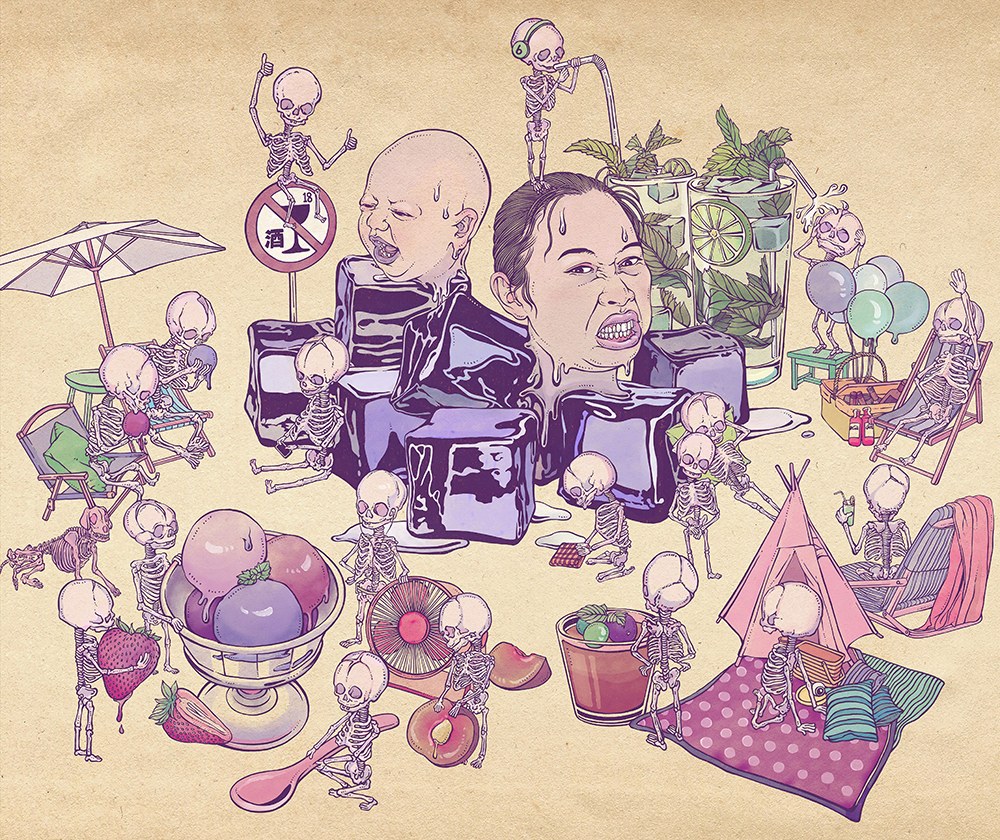
Ice Cube Hell swaps fire for cold. A woman and a baby are frozen into purple ice cubes that slowly melt into a puddle, while the skeletons enjoy a summer afternoon around them, with a beach umbrella, deckchairs, a tent, balloons, mojitos, ice cream and a no-drinking sign for under-18s.
The series works through that mix of comedy and horror. The scenes are busy, detailed and often funny, full of the small pleasures of food and leisure. Only slowly does it become clear that the ones suffering at the centre are always the same, and that no one around them seems to notice.
Sins, and what goes on inside a girl’s head
You’s other recent work takes a more graphic, contemporary direction while staying with the same concerns. A series on the deadly sins, with titles such as Gluttony, The Feast of Emptiness, Greed, Hands That Are Never Full and Sloth, The Comfort of Collapse, places young women in cluttered modern interiors, framed by lines of scripture in Chinese, several of them from the Book of Proverbs. One woman sits on the floor in front of an open fridge eating cereal; another, glass of red wine in hand, plays mahjong as banknotes rain down around her.
In What’s in a Girl’s Head, a pair of independent illustrations, a central female portrait is surrounded by overlapping fragments: windows onto memories, routines, dreams and the people and places that shape a sense of self. Inside the figure’s head is a smaller scene, a private psychological space set apart from the outside world. The fragmented composition reflects how thoughts rarely follow a straight line, as memories, observations and emotions overlap and colour one another. You has said she wanted to make visible the richness of inner experience, especially the parts that tend to stay unseen or unspoken.
Making the unspoken visible
That aim could stand for her whole practice. Whether the setting is a scroll-painting inferno or a modern apartment, You returns to moments that usually go unremarked, particularly in the lives of women and of marginalised communities, and gives them a weight and a strangeness that make them hard to ignore. Her pictures reward a long look, and many viewers will recognise something of their own lives in them.
More of Zhiyu You’s work can be seen on her website and on Instagram at @zyuyou_art.