

Moss creeping over weathered stone is one of the slowest things in nature. It takes years to cover a wall or a fallen statue, and by the time it has, the thing underneath has become something else. For the knitwear designer Ruoyan Er, that process became the starting point for a collection.
Er’s latest body of work, AFTERMatter, uses knitting, deconstruction and hand-developed textile techniques to explore time, decay and reconstruction. This year it has also brought her one of the design world’s international honours: she has been named a 2026 MUSE Design Awards Platinum winner in the Fashion Design – Textile & Materials category.
A designer who thinks in fibre
Er is a fashion artist and designer specialising in knitwear, textiles, draping and garment construction. Her practice is concerned with the relationship between material, emotion, memory and time, and she approaches clothing as both a tactile object and a form of visual storytelling.
She currently works as a lead designer for Peter Jensen and Yours Truly, Copenhagen, developing knitwear and textile-based designs. Her professional work has also included collaborations with SHEIN and Alibaba on fashion, visual and design projects, and she has worked across freelance design, styling, creative development and teaching, collaborating with more than 20 fashion brands and creative projects internationally.
Alongside that commercial career, she has built an independent practice rooted in material experimentation and craft. AFTERMatter is its most ambitious expression so far.
Ruins, moss and two novels
The collection draws on images of moss reclaiming weathered stone and of fragmented monuments, and on two very different novels: Aldous Huxley’s Brave New World and Gabriel García Márquez’s One Hundred Years of Solitude. One imagines a perfectly ordered society, the other a family and a town slowly consumed by time and repetition. Between them, Er found the themes that run through AFTERMatter: how systems collapse, how memories accumulate, and how forms are continually remade.
That idea is built into the garments themselves. Er works through deconstruction and reconstruction, taking knitted structures apart and reassembling them, so that fragments and traces of earlier forms become the material of new ones. The surfaces are dense with texture: open, laddered stitches, frayed edges, raised motifs and areas that look almost eroded.
The looks
The collection was photographed outdoors and in rural and roadside settings, in a series of looks with titles that point back to its themes.
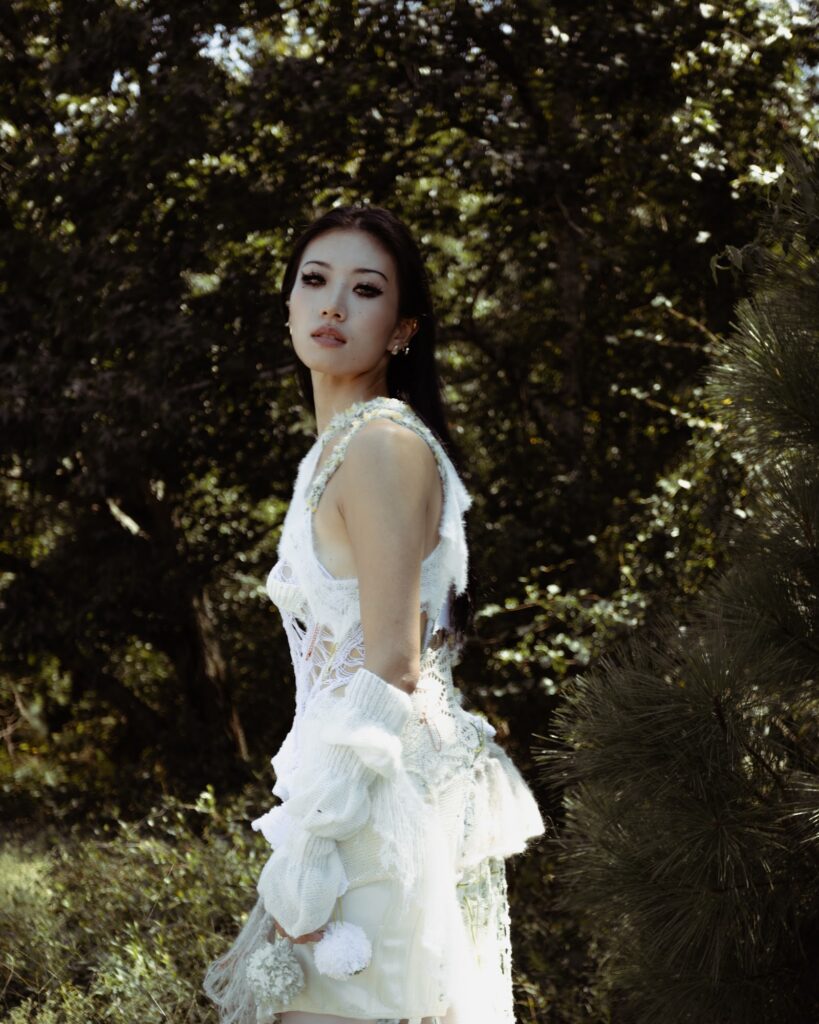
Entropy, named after the tendency of all systems to slide toward disorder, is a white, sculptural knit dress that seems to be coming apart and growing at the same time, with ruffled, torn and gathered sections spilling from the bodice. It was shot in a dark woodland, among rocks and fallen trunks.
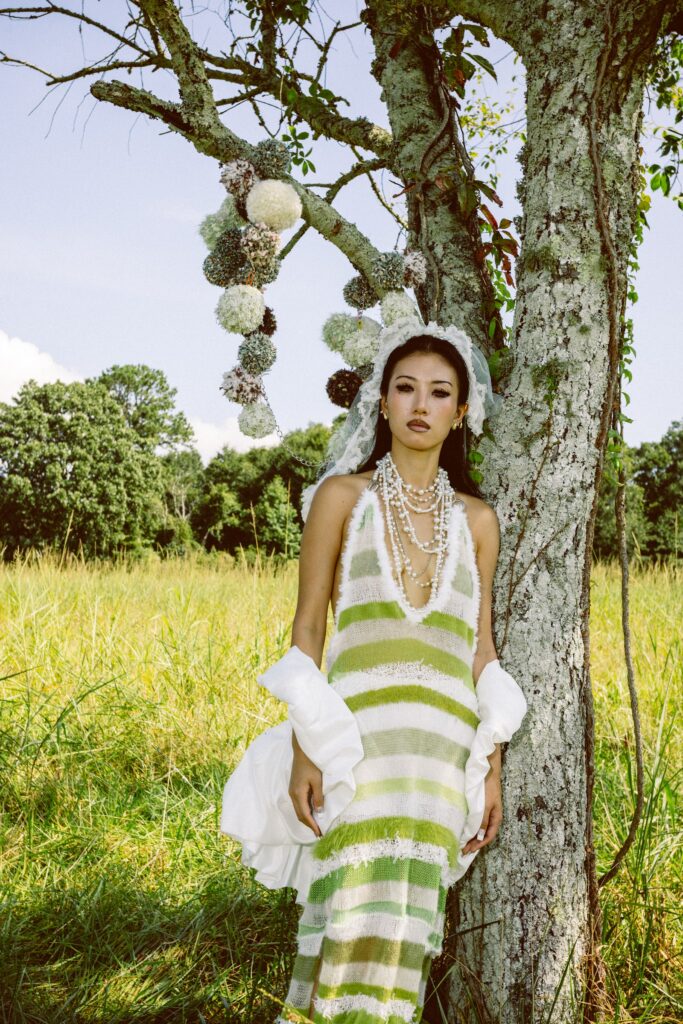
Verdigris takes its name from the green patina that forms on weathered copper and bronze, including the old public statues that inspired the collection. It is a long, fitted dress knitted in bands of pale green and cream, styled with a white knitted headpiece and long ropes of pearls, and photographed beside a rusting barn and an old farm truck.
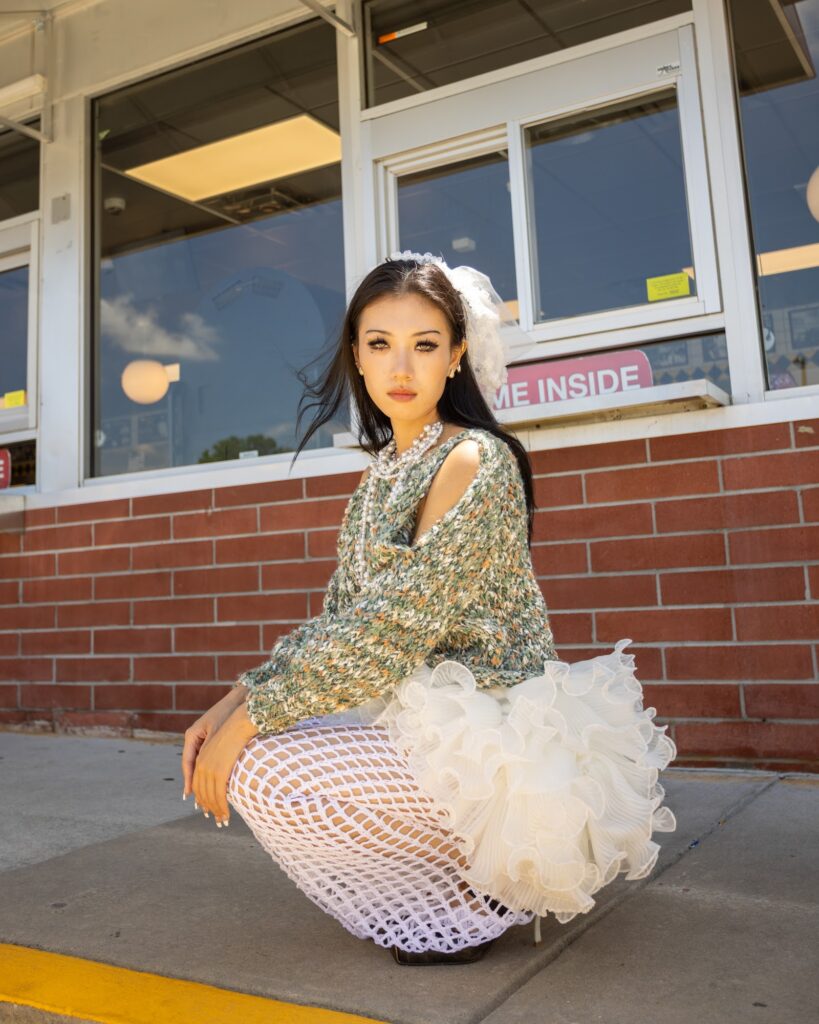
Lichenfall is the mossiest of the looks: a heavily textured knit in mottled greens and creams that recalls lichen on stone, worn with net tights and a froth of white tulle. The shoot took it somewhere unexpected, a roadside diner, where the organic texture of the knit plays against tiled walls and plastic booths.
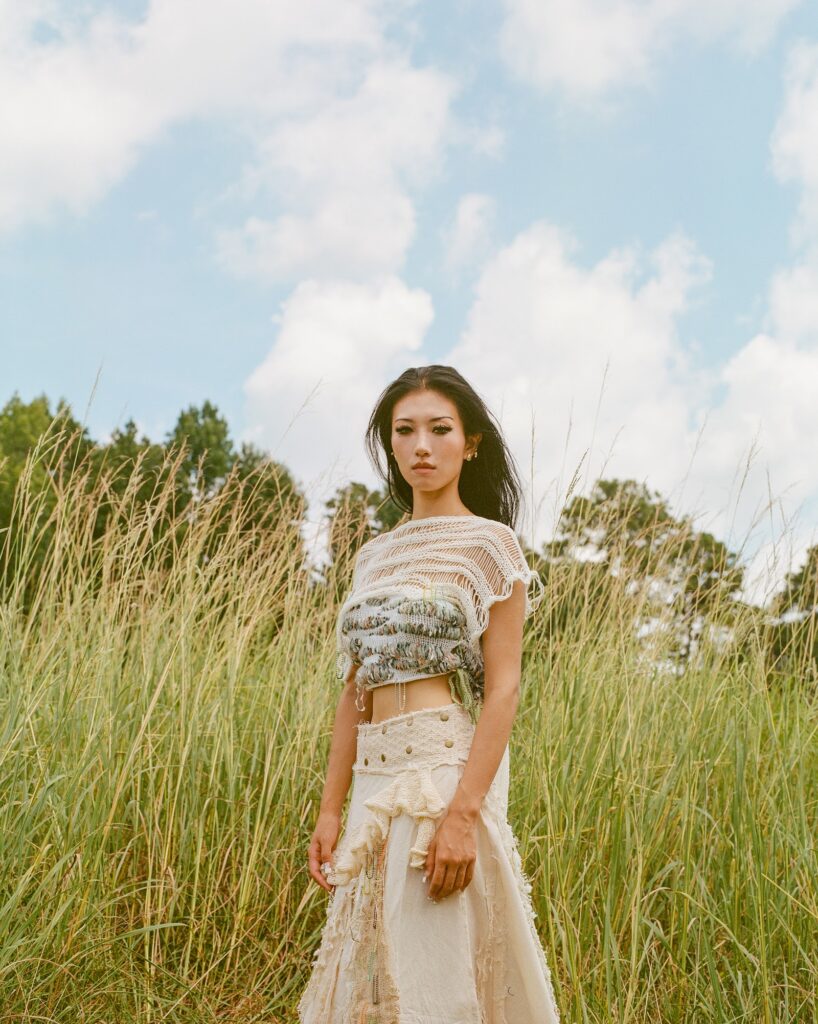
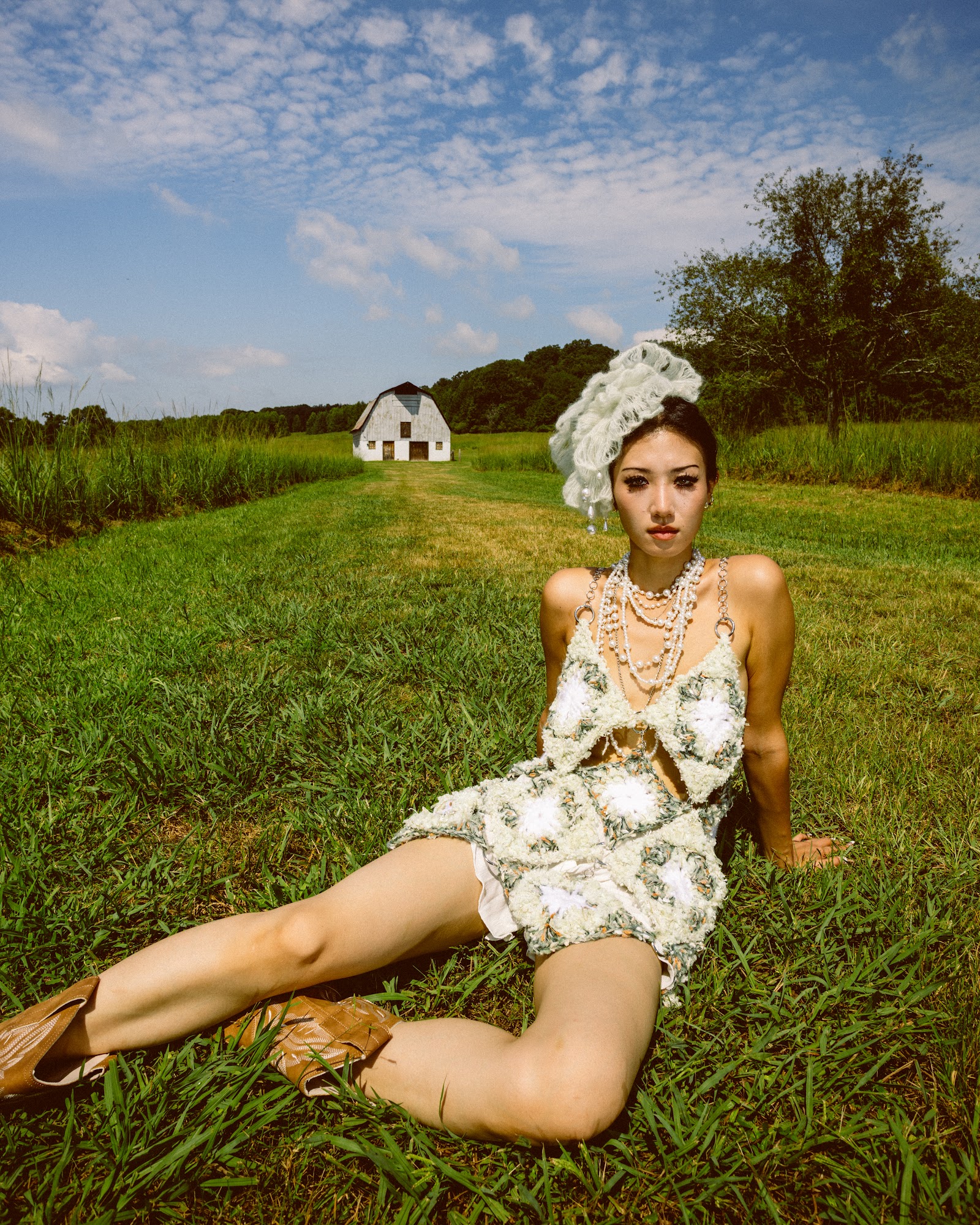
Palimpsest, a word for a manuscript scraped clean and written over, with traces of the old text still visible, is a softer look in cream and ivory, combining a striped knitted top with a long, layered skirt. And Reliquary, shown at the top of this page, is a short knitted romper covered in round medallion motifs and finished with layers of pearls, as if the wearer were carrying small relics of the past.
A Platinum win
The MUSE Design Awards, run by the International Awards Associate, recognise work across architecture, interiors, product, fashion and communication design. In its letter to Er, the MUSE committee announced her as a Platinum winner in the Fashion Design – Textile & Materials category for 2026, praising her concepts and innovation.
The award recognises what makes AFTERMatter distinctive. It treats a sweater stitch the way a sculptor might treat stone, as something that can be broken, weathered and rebuilt, and it suggests that the marks left by time can be the most beautiful part of a garment.
More of Ruoyan Er’s work can be seen on her website and on Instagram at @Geki_b.