


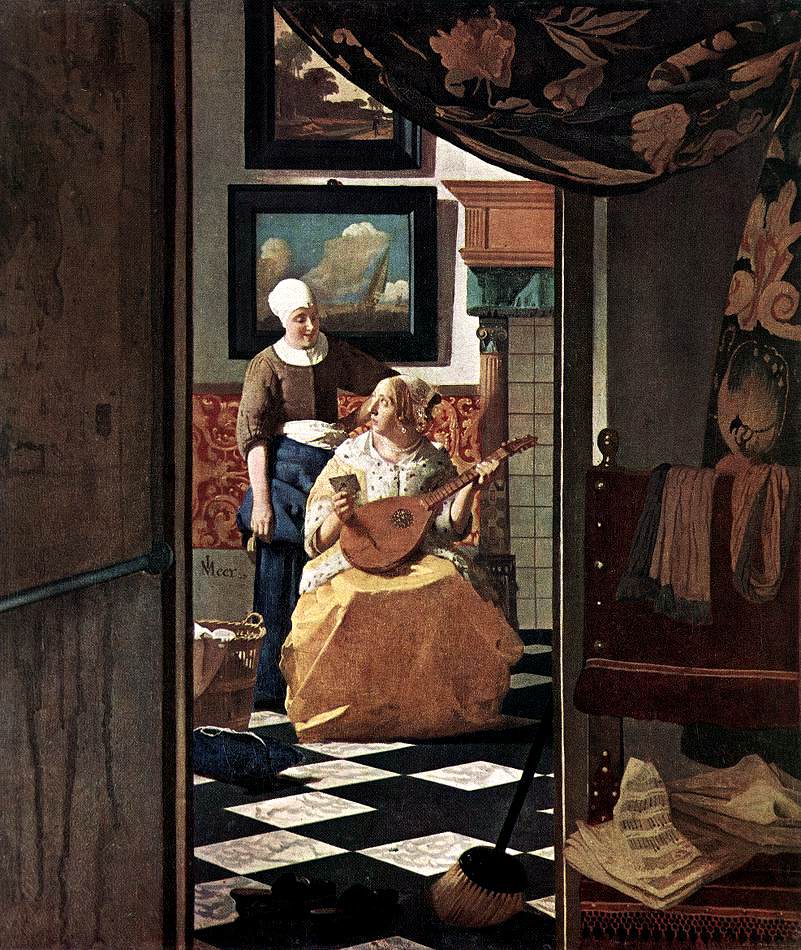
Only around 35 paintings are generally accepted as the work of Johannes Vermeer, which makes every one of them precious, to museums and to scholars. Now an experienced Vermeer specialist has argued that two of the best known, The Love Letter at the Rijksmuseum in Amsterdam and The Glass of Wine at the Gemäldegalerie in Berlin, were painted by someone else.
The case is made by the Dutch-born art historian Adriaan E. Waiboer in a long article, “Vermeer in Dispute: The Authorship of The Glass of Wine and The Love Letter”, published in the peer-reviewed Journal of Historians of Netherlandish Art. Waiboer is a former head of collections at the National Gallery of Ireland and was lead curator of the 2017–18 exhibition Vermeer and the Masters of Genre Painting, which travelled from the Louvre to Dublin and Washington.
A “skilful pastiche” in Berlin
Waiboer’s sharper verdict is reserved for The Glass of Wine, a scene of a man offering a seated woman a drink, usually dated around 1659–61. He argues that it borrows its composition, costumes, floor and window from two other Vermeers, A Woman Interrupted at Her Music at the Frick Collection in New York and A Woman with a Wineglass in Braunschweig, while also drawing on ideas from contemporaries such as Gerard ter Borch and Pieter de Hooch.
Comparing details such as the carpet, the music book, the lion’s-head finials and the hands and faces with undisputed works, he finds the execution less refined, and he reads the painting as a skilful pastiche by an artist who knew Vermeer’s work intimately, quite possibly someone in his studio.
Doubts over The Love Letter
He is more cautious about The Love Letter, in which a maid hands a letter to a woman holding a cittern, seen through a dark doorway. Waiboer describes the faces, hair and fur-trimmed jacket as crude compared with late works such as The Lacemaker, and sees the picture as a variation on several of Vermeer’s late compositions, including Mistress and Maid. He points to the painting’s lack of early provenance and to features of its signature, but acknowledges that the signature makes the question harder to settle. His conclusion is that the two works were painted by different artists, inside or outside Vermeer’s workshop.
The museums stand firm
Neither museum accepts the argument. Dagmar Hirschfelder, director of the Gemäldegalerie, said it would “carefully examine the arguments”, but noted that Waiboer’s assessment relies on high-resolution images and on viewing the paintings behind glass, rather than new technical examination, The Art Newspaper reports. Pieter Roelofs, head of fine arts at the Rijksmuseum, said research carried out for the museum’s blockbuster 2023 Vermeer exhibition had confirmed that The Love Letter is by Vermeer himself.
Why the Vermeer canon keeps shifting
Waiboer’s article lands in a field that has been unusually unsettled. In 2022, curators at the National Gallery of Art in Washington argued that their Girl with a Flute was made by an associate of Vermeer, while the Rijksmuseum’s 2023 retrospective, which brought together a record 28 paintings, took a more generous view of several disputed works. Growing interest in the idea that Vermeer ran a studio, with assistants or followers producing work close to his style, has made the boundary between master and workshop a live question.
For now, both paintings remain on the walls as Vermeers. Waiboer is writing a book on the artist, which he expects to publish around 2028, and the debate is unlikely to be settled before then.