

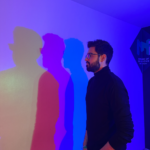

Contemporary jewelry today occupies a space far beyond ornamentation, operating as an expressive medium that bridges gesture, memory, and personal ritual. Within this evolving landscape, jewelry artist Chufei Yang has developed a practice that positions metalwork and sculptural objects as carriers of narrative—objects that track the body’s movements and form quiet dialogues between material and wearer.
Yang’s artistic foundation is shaped by two distinct educational contexts. She received her BFA in China before earning an MFA in United States. This trajectory situates her work between design methodology and studio-based research, equipping her to move fluidly from wearable pieces to object-based compositions while maintaining a consistent material vocabulary.
A defining aspect of Yang’s practice is her emphasis on material-driven narratives. Rather than approaching jewelry as a fixed object, she treats each piece as an active site where body, interaction, and ritual intersect. Elements such as weight, balance, and surface become central to her process, shaping pieces that respond to motion and engage the wearer’s sensory awareness. Through this lens, jewelry becomes not only an adornment but also a structure that records personal gestures and intimate routines.

This sensitivity to material and gesture has been reflected across a series of exhibitions that chart Yang’s growing international presence. In the United States, she has participated in New York City Jewelry Week (NYCJW), with presentations at BKMW Gallery (Brooklyn, 2024) and Steuben Gallery (Brooklyn, 2023). These exhibitions place her work within the wider discourse of contemporary jewelry in New York, where the boundaries among art, design, and fashion continue to overlap and evolve.
Yang’s practice also extends across global platforms. In Poland, she is featured in AMBERIF AUTUMN 2025, an event associated with the programming of Gdańsk Jewelry Week, a context that highlights innovative directions in contemporary jewelry. In Argentina, her work appeared in “Cucharas” at Complejo Museológico Explora Salta (2024), introducing her practice to audiences engaged in Latin American craft and material cultures. These exhibitions reveal how her work resonates across different cultural settings, finding connection through material experimentation and embodied interaction.
Publication-based venues add another dimension to Yang’s visibility. Her work has been included in Gallerium projects and in The Book of Arts publication Light, Shadows, Reflections – 2025, a juried international platform that integrates exhibition, documentation, and global online presentation. In this setting, Yang’s pieces are positioned within a broader investigation of light, surface, and perception, aligning her practice with artists exploring the optical and tactile qualities of contemporary materials.
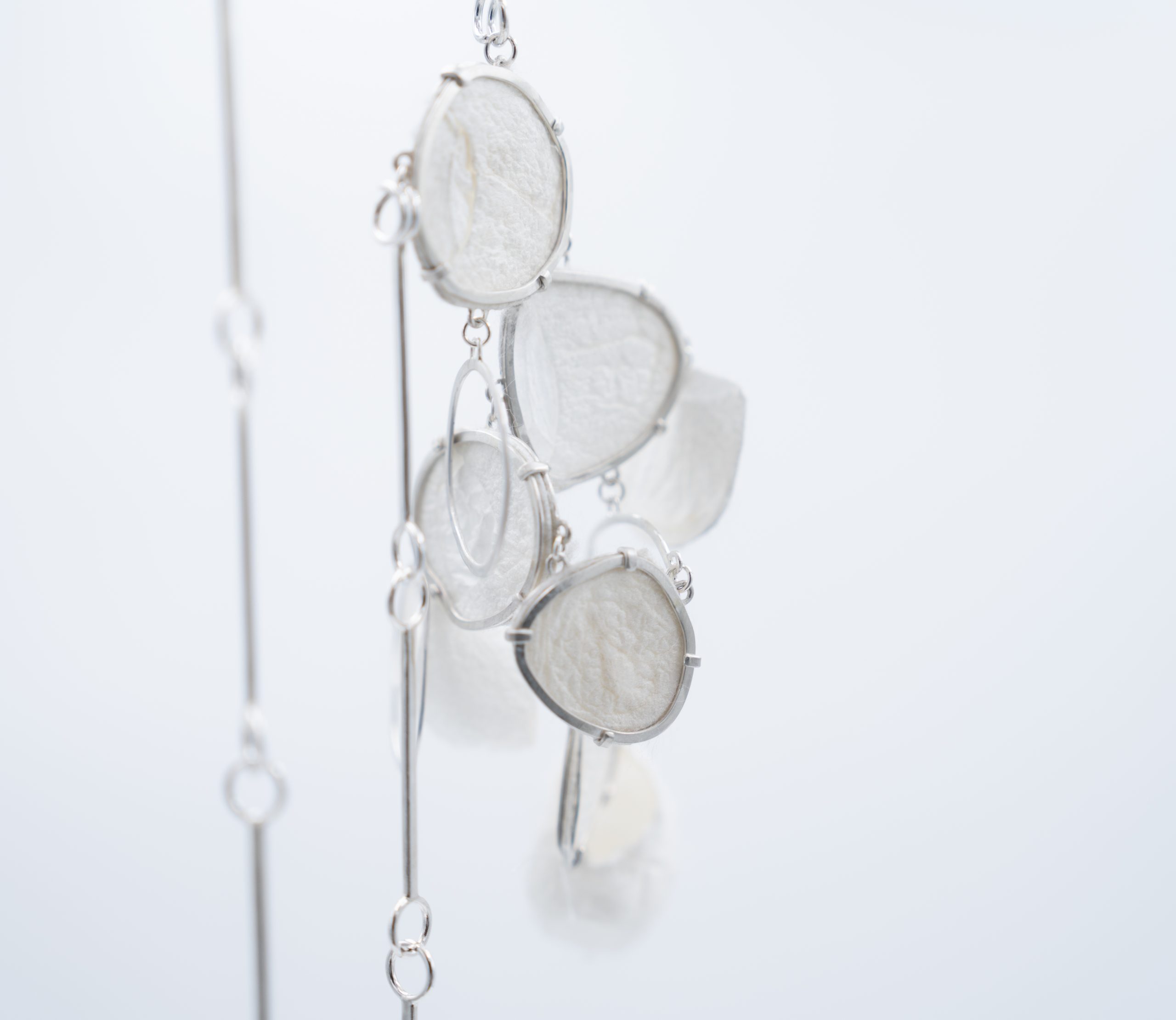
Alongside her exhibition and curatorial activities, Yang has been recognized by multiple international award programs. She is a Silver Winner in the French Design Awards (Fashion Design, Handmade, 2025) and a Silver Winner in the MUSE Design Awards (Jewelry, 2025), distinctions that acknowledge the clarity of her formal decisions and her thoughtful approach to material considerations. In 2024, Yang received the Maxwell/Hanrahan Foundation Materials Award, which highlights her commitment to material inquiry and her ability to translate experimentation into refined, resolved work.
Yang’s pieces operate across multiple scales. As wearable forms, they address intimacy, movement, and the subtleties of bodily interaction. As sculptural objects, they engage questions of space, display, and the physical presence of materials. Her training in both Chinese and American institutions informs this dual orientation, allowing her to draw from varied cultural and pedagogical approaches while maintaining a precise attention to detail.
Within the broader field of contemporary jewelry and object-based art, Yang’s trajectory offers insight into how material experimentation, craft discipline, and conceptual investigation can intersect within an increasingly international framework. Her work approaches jewelry as a platform for engaging embodied ritual, sensory experience, and the layered relationship between object and wearer. As her practice continues to expand across regions and formats, it contributes meaningfully to ongoing conversations about the evolving role of jewelry within today’s art and design landscapes.