

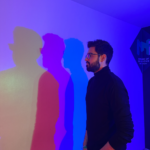

A discarded plastic bottle. Torn packaging. Creased bubble wrap. Everyday items we move past with barely a look. They are the discards of society; substances that served their purpose and would now fruitlessly exist as ‘waste’ for millions of years before they could decompose. But for Jichi Zhang, these sore wounds of permanence are not without purpose. In his eyes lies a singular vision to transform these industrial vestiges into ethereal works of art.
“Art is not what you see, but what you make others see.” — Edgar Degas
In a world obsessed with clarity and order, Jichi Zhang makes a quiet case for uncertainty. His artworks don’t shout for attention—they wait. Hovering somewhere between visibility and disappearance, his pieces—often made from post-industrial remnants like plastic sheeting and packaging—speak to fragility, ambiguity, and the tension of almost becoming something concrete but stopping just a step short. Folded, creased, barely held together, Zhang’s sculptures are ethereal and atmospheric, resisting finality. You could walk past one and miss it entirely, only to sense it moments later in the corner of your vision. As you turn around, you come face-to-face with an assemblage of leftovers metamorphosed into something more. In Zhang’s hands, even the discarded becomes poetic.

At the heart of Zhang’s practice is a deep respect for materials and their agency. He does not command; he collaborates. His curious approach towards his art lies not in what he does, but in what he doesn’t. Many of his sculptures are barely touched—creases that look accidental are, in fact, preserved with care. His recent body of work, especially the series am, reflects his fascination with states of suspension: neither fully formed nor undone, neither present nor absent. These pieces embody what Zhang calls “half-presence”—an existence that defies certainty and thrives in flux. For him, impermanence isn’t failure. It’s potential. A curled edge, a softening fold, a trembling sheet—all suggest that transformation is always underway. He avoids the conventional artistic aims of exhibition and explanation, instead inviting viewers to encounter his works rather than interpret them.
Zhang’s quiet yet resonant worldview is shaped in part by his cross-cultural journey. Born in 2001 in Hohhot, China, he currently lives and works in London. He is a graduate of Central Saint Martins, where he pursued a BA (Hons) in Fine Art along the XD (Expanded) Pathway. In 2024, he undertook an Erasmus exchange at the Universität der Künste in Berlin, studying under Klasse Schutter. His educational path mirrors the essence of his practice—diverse, experimental, and always evolving.

Despite his youth, Zhang has already built an impressive portfolio of exhibitions and accolades. His upcoming solo show, am, will open in 2025 at Absent Gallery in Guangzhou, China—a fitting title for an artist invested in the nuances of presence and absence. Zhang’s group exhibitions have spanned major cultural cities and institutions: from Re-Activate at The National Gallery, London, to ROTOR at the Louvre Museum, Paris. His works have also been shown at the Saatchi Gallery in London as part of ART COLLECTIVE: From the One to the Many, and at Changchuan Art Museum in Suzhou, China. Notable projects such as Backroom, der Gepäckschiebekarren, and Pre-am further demonstrate his ability to create subtle yet immersive experiences. He has exhibited multiple times at The Koppel Project Station in London, and his works have entered the collections of LAC (London) and Atypia (Shanghai). In 2023, he was selected for “ONES TO WATCH” at London Fashion Week—a recognition that underscores the interdisciplinary allure of his work.
But there is more than one tool in Jichi Zhang’s arsenal of talents. Outside of the art world, Zhang has made contributions in a diverse range of fields. In 2024, he co-authored a scientific paper published in Scientific Reports that focused on advanced music classification using a combination of neural networks and molecular movements of gas, a research that required Zhang’s unique combination of intellectual prowess and artistic bent.
As for the future, Jichi Zhang’s trajectory is anything but linear – by design. Much like his art, his life doesn’t seek permanence. He aims to soar, whichever way the wind blows, but only to newer heights. With an upcoming solo exhibition, a growing international presence, and a steadfast refusal to conform to the spectacle of contemporary art, Zhang is carving a space for quiet rebellion. At just 23 years of age, he has already achieved more than what most people hope for in a lifetime. But for him, it is merely the beginning of his ascent.
One fold, one shimmer, one impermanent gesture at a time, he is reminding the world that sometimes, what trembles at the edge of visibility holds the most enduring weight.