


It is the kind of story the art world rarely gets: a major sculpture by one of America’s great modernists, lost in a shopping-mall basement for nearly four decades, rediscovered by appraisers, restored and sold to General Motors for a reported $1 million. Months after it went up in GM’s new Detroit headquarters, the tale of Harry Bertoia’s forgotten “clouds” is circulating widely again online, along with questions about how the restoration was done.
From Flint to a basement in Southfield
The J.L. Hudson Company, the Detroit department store chain, commissioned the work from Bertoia in 1970 for the Genesee Valley Mall in Flint, Michigan. It consists of two cloud-like masses of rigid steel wire coated in brass, bronze and copper alloys, together standing about 26 feet tall, and it hung in the mall’s central court for roughly a decade.
When the mall was renovated around 1980, the sculpture was taken down and sent to Northland Center in Southfield, another Hudson’s-anchored mall outside Detroit, for what was meant to be temporary storage. It never went back up. Northland closed in 2015 and was bought by the city of Southfield for $2.4 million. When appraisers went through the building in 2017, they found the Bertoia in the basement, grimy, corroded and missing pieces of steel.
Celia Bertoia, the artist’s daughter, inspected it. The city paid for cleaning and structural repair, carried out by Flatlanders, a Michigan restoration firm, and then sold the piece to GM.
A homecoming at Hudson’s Detroit
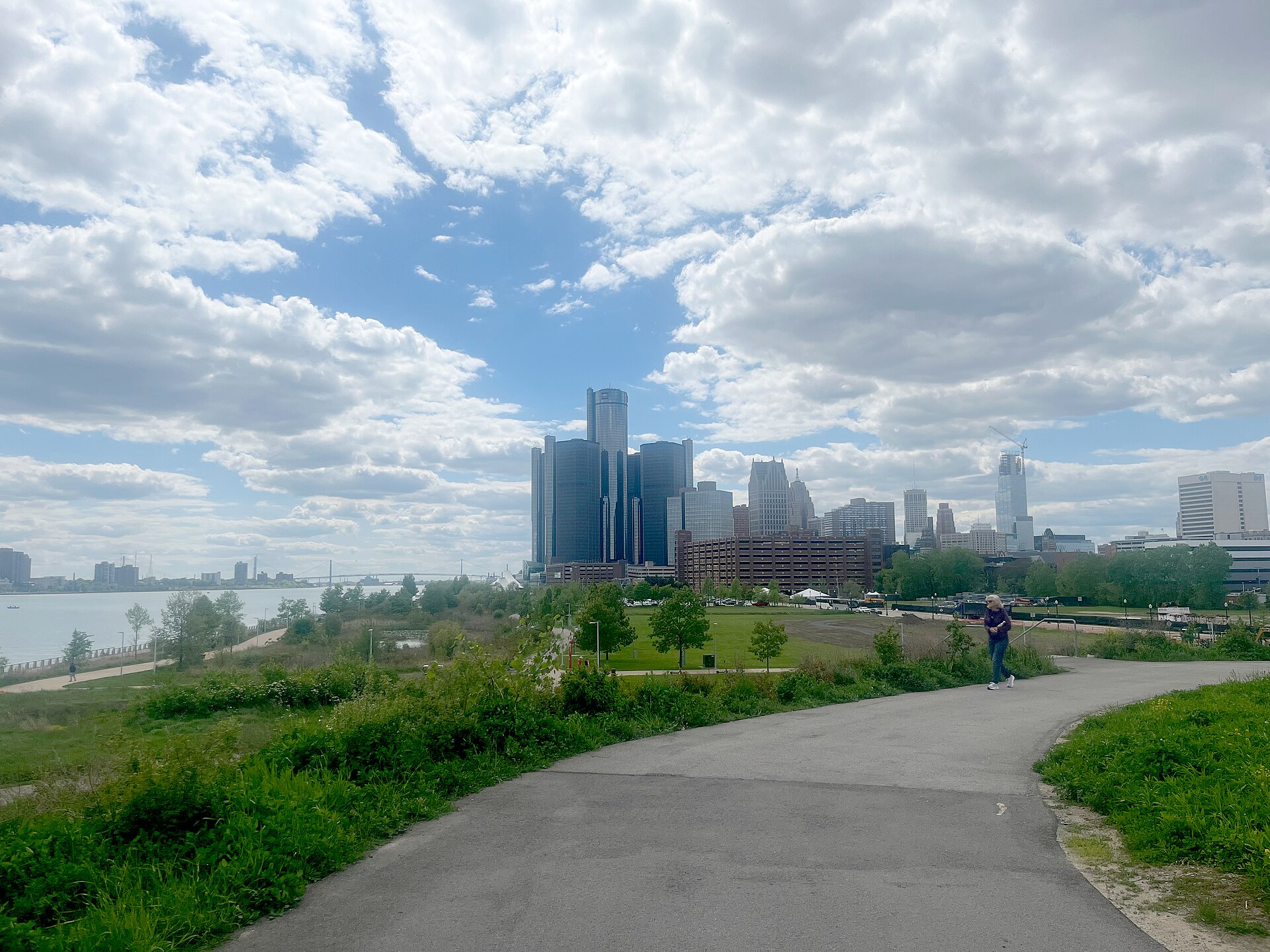
GM installed the sculpture in December 2025 in the atrium of its new global headquarters at Hudson’s Detroit, which stands on the site of the flagship store of the company that commissioned it 55 years earlier. To get it inside, crews cut a 75-foot-tall opening in the side of the building and lifted the two modules in with cranes.
For GM, the link goes deeper than the Hudson’s name. Bertoia, born in Italy in 1915, came to Detroit as a teenager and studied at the Cranbrook Academy of Art in nearby Bloomfield Hills. One of his first big architectural commissions was a large metal screen for Eero Saarinen’s General Motors Technical Center in Warren in the 1950s. Crystal Windham, GM’s executive director of industrial design, described Bertoia as a master of shaping metal, a skill she tied directly to the company’s own design work.
Bertoia is best known to the public for the wire Diamond chair he designed for Knoll in the early 1950s, but in the decades that followed he devoted himself largely to sculpture, from monumental architectural pieces to the “sonambient” sound sculptures he made in his barn in Pennsylvania. He died in 1978.
Questions over the restoration
The renewed attention has also revived a dispute. In August, the Detroit journalist Charlie LeDuff reported claims by two former Flatlanders employees, made in sworn affidavits, that the sculpture had been spray-painted rather than properly conserved before it was handed over.
Flatlanders’ owner, Ken Thompson, denied the accusations and said the two men had a grudge against him. He later told LeDuff the piece had been coated with a high-gloss amber lacquer to protect it from rust, which he said did not affect its value. A GM spokesman said the company knew the sculpture had been damaged and was considering its next steps. The claims have not been tested by an independent conservator or in court.
Whatever comes of that, the piece has completed an unlikely circle: commissioned by Hudson’s for a mall in Flint, forgotten under another mall in Southfield, and now hanging over the spot in downtown Detroit where Hudson’s flagship once stood.