

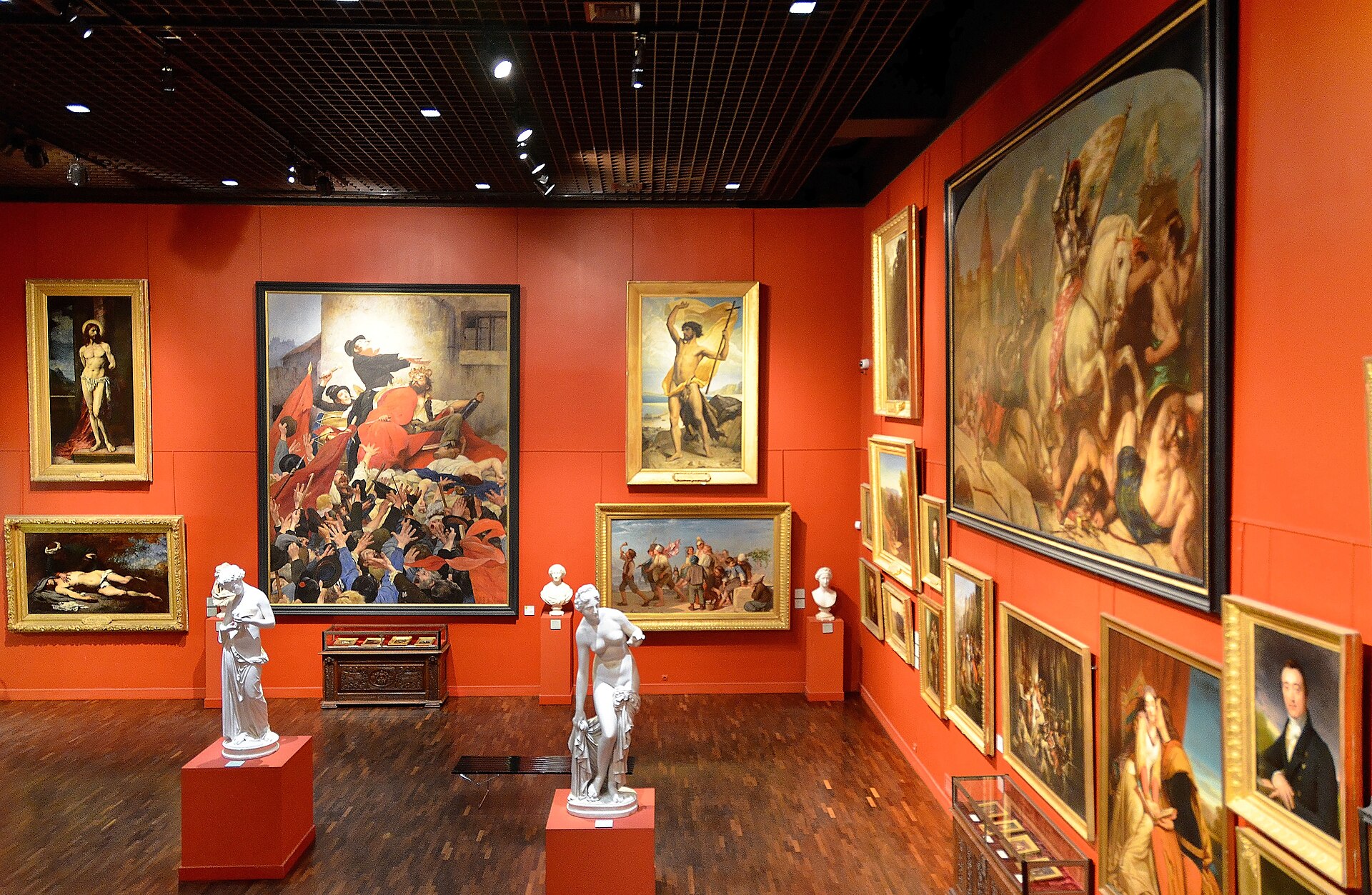
In the summer, the Musée des Beaux-Arts d’Orléans did something few museums would dare. It put up “Wanted” posters around the city and online, in the style of an American Western, each showing a painting that had vanished from its collection. Now the campaign has produced its first result. A small 17th-century Dutch picture, looted during the German occupation of the city in 1940, has been tracked down in Switzerland and is on its way home.
The museum is still looking for 424 paintings. Among them are works attributed to Holbein, Correggio, Bronzino, van Dyck and Chardin.
A drinker in Lucerne
The recovered painting is Le Buveur (The Drinker) by Willem Cornelisz Duyster, a Dutch painter of the 1620s and 1630s best known for small, finely painted scenes of soldiers and card players. It shows a seated man holding an empty glass.
It was spotted by an Orléans resident who had seen the posters and went looking through online auction catalogues. The picture had been consigned to an October 17 sale at the Gloggner auction house in Lucerne, catalogued as a study rather than the finished painting the museum had lost. The museum contacted the auction house, and the owner, who had bought the work at auction in London in the 1990s, agreed to return it once shown the evidence linking it to Orléans.
The museum’s director, Olivia Voisin, has described the hunt in light-hearted terms. “It’s like a game, it’s like Pokémon,” she told The New York Times. “We have to catch them all.”
What happened in 1940
The story behind the posters is darker. In June 1940, as German forces reached Orléans, the Musée Paul Fourché, an annex of the fine arts museum filled with more than 300 paintings given by the local collector Paul Fourché, was looted and then destroyed by fire. The Hôtel Cabu and the city’s Joan of Arc museum burned as well.
For decades it was assumed that the Fourché paintings had simply gone up in flames. In the 1990s that began to change. In 1994 the French Ministry of Foreign Affairs found references to the collection in Nazi archives, suggesting that at least some of the works had been taken before the fire and continued to circulate.
Not every loss dates from the war. According to the museum, other paintings disappeared over the 20th century after being placed in government offices and other institutions, a common practice in France before the museums law of 2002. Because French museum collections are inalienable, Orléans’ claim to all of them has never lapsed.
The first four returns
Le Buveur is the latest of four works to come back in the past two years. A German couple who had bought Achille-Etna Michallon’s 1818 oil sketch The Death of Roland in the 1980s returned it in 2026 after noticing the museum’s labels on the back. An anonymous 1546 painting of Christ between Saint Paul and Apollos of Alexandria, bought by the museum in Beauvais in 1994, was handed back about thirty years later. And Louis Neillot’s 1935 landscape Sous-bois, Bellevue, which disappeared from a public office in the 1970s, was traced to an auction by the lawyer Matthieu Semont and returned in 2024.
The masterpieces still missing
The museum has published its full list of missing works, with old photographs, inventory numbers and archive notes. Some of the most significant entries include:
- Hans Holbein the Younger, Portrait of a Man
- Attributed to Correggio, Head of a Little Angel, a fragment of a larger Virgin and Child
- Attributed to Bronzino, Portrait of a Woman, once thought to show Caterina de’ Medici
- Lorenzo Costa, Madonna and Child, an attribution the great Italian art historian Roberto Longhi called “indisputable” after seeing it in 1920
- Workshop of Raphael, Madonna and Child with the Infant Saint John
- Anthony van Dyck, four paintings, all lost during the Second World War
- Pieter Brueghel the Younger, The Kingdom of Pluto
- Jacob Jordaens, Vanitas
- Luca Giordano, The Adoration of the Magi
- Jean Siméon Chardin, Portrait of Charles Nicolas Cochin, bought by Fourché in Bordeaux in 1914
- Eugène Boudin, Chenal à marée basse
One case has a more recent twist. Alfred Sisley’s Le Jardin au bord de l’eau was presumed lost in the war, then found in the museum’s own storage around 1952, only to be stolen in 1998 by Stéphane Breitwieser, the French thief who took hundreds of objects from museums across Europe. It has never been recovered.
Why posters work
Most of the missing pictures are not famous enough to trigger alarms when they come up for sale. They are small, often unsigned, and may have been reattributed, renamed or cut down since 1940. As Le Buveur shows, the people most likely to notice one are not specialists but ordinary collectors and enthusiasts who happen to remember an image.
That is the bet Orléans has made. By turning a dry archive into a public game, the museum has turned anyone who sees the posters into a potential detective. The museum asks anyone who recognises a work, or finds an old Orléans label on the back of a canvas, to get in touch. The full list is on the museum’s Wanted page.