

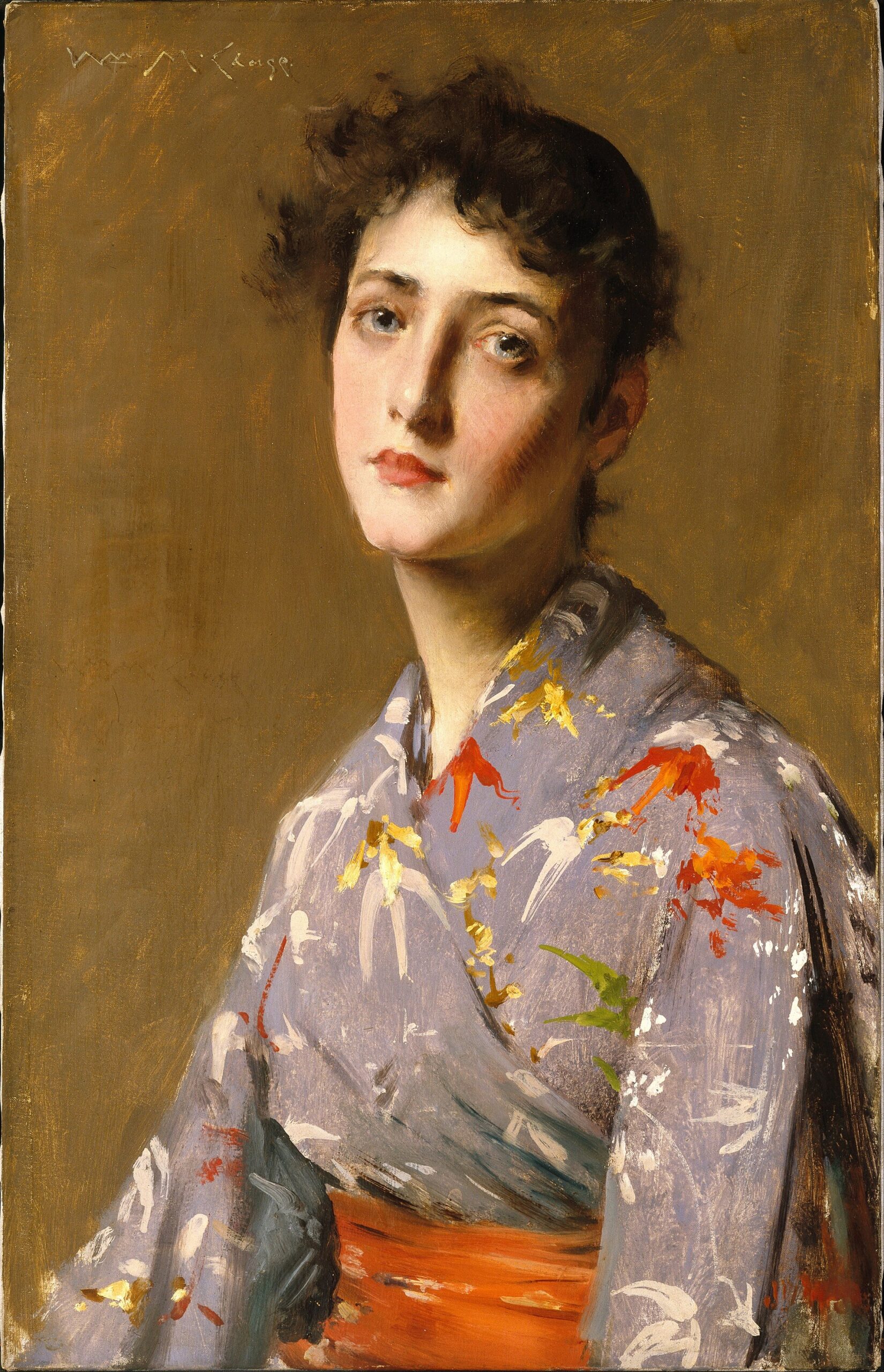
For decades, visitors to the Parrish Art Museum on Long Island have been looking at a William Merritt Chase painting that was not quite what Chase painted. A curl of hair had disappeared from beneath the sitter’s ear. Parts of a decorative screen had faded away. Even the artist’s signature had been painted over so heavily that it may have been mistaken for part of the carpet.
Those details have now been found again, with some help from artificial intelligence, and the restored picture went on view this weekend.
A woman in a blue kimono
The painting is A Comfortable Corner, also known as The Blue Kimono, made around 1888. It shows a woman reclining in a richly furnished interior, wearing a deep blue kimono and holding an uchiwa, a flat, round Japanese fan. It is typical of Chase’s work in the 1880s, when he was one of the leading American painters caught up in the fashion for Japanese objects and dress, and filled his famous New York studio with fabrics, screens and curiosities.
The Parrish’s associate curator, Kaitlin Halloran, calls it an important work within Chase’s oeuvre. But time had not been kind to it.
Two restorations too many
The canvas has been restored at least twice, including a major campaign in the 1960s. That treatment gave it a heavy, burlap-like lining, along with retouching, blotchy inpainting and uneven layers of varnish, some of which discoloured over the years. The painting also seems to have been reduced in size at that point, perhaps to fit a new stretcher or because damaged edges were folded over.
When the conservator Suzanne Siano and her team at Modern Art Conservation in New York took on the picture, they suspected that more had been lost than just varnish.
Where AI came in
The key evidence was an old black-and-white photograph of the painting, taken before the later restorations. The team used AI to combine that photograph with a colour image of the painting as it is today, producing a composite that showed exactly where the two diverged.
The comparison revealed the missing curl of hair, the vanished passages of the screen, and areas where delicate brushwork had been covered by heavier marks. It also turned up pentimenti, changes Chase made himself as he worked, which do not appear in the old photograph. Siano believes earlier restorers may have misread the surface and cleaned towards what they thought was the original, possibly removing some of the artist’s own adjustments along the way, though she notes that this is hard to prove.
She was clear about what the technology did and did not do. It was useful, she said, “largely because of its speed,” and considerably faster than assembling the comparison by hand. The actual conservation, she stressed, is carried out by a highly skilled individual or team. “AI is none of those things.”
A growing role for machines
The project, supported by a grant from Bank of America, is a modest but telling example of how AI is entering conservation studios. Rather than repainting anything, it was used as a fast and precise way of comparing evidence, the kind of tedious visual work conservators have long done by eye with overlays and light boxes. The decisions about what to restore, and how, stayed with people.
That distinction matters in a field where anxiety about AI runs high, and where restorations, as this painting shows, can do lasting damage when they go wrong.
See it on Long Island
The restored A Comfortable Corner is now on show in William Merritt Chase and Walter Granville-Smith: American Impressionists of the East End at the Parrish Art Museum in Water Mill, New York, which opened on November 14 and runs until March 21, 2027. Chase spent his summers on the East End of Long Island in the 1890s, teaching at the Shinnecock Hills Summer School of Art, and the exhibition pairs him with Granville-Smith, another painter of the region.
The project was first reported by The Art Newspaper.