


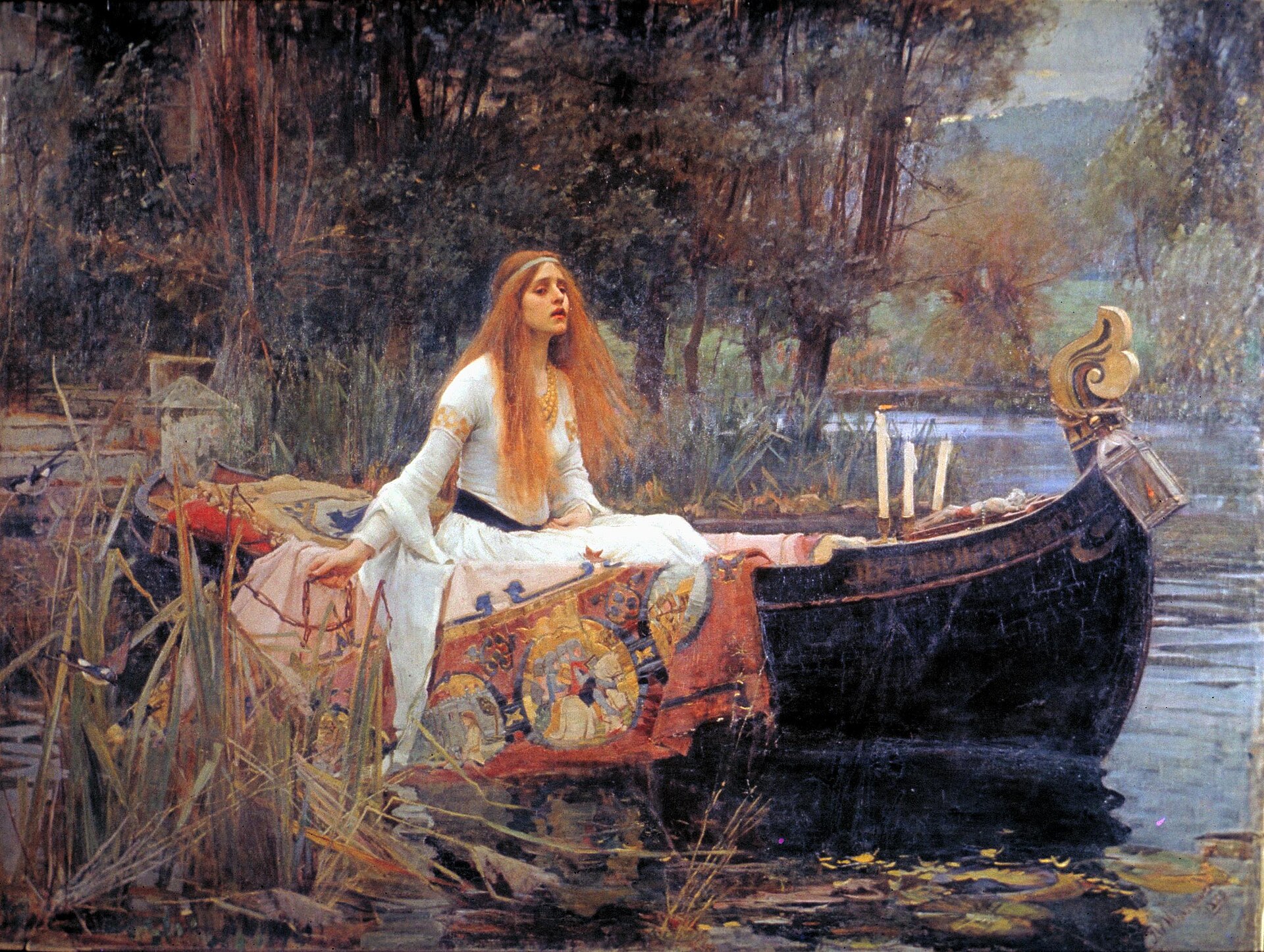
Few Victorian paintings have had a second life quite like John William Waterhouse’s The Lady of Shalott. Painted in 1888 and now one of the best-loved works at Tate Britain in London, it turns up on posters, phone wallpapers, book covers and mood boards, and it has been drawing a fresh wave of searches online this month. Here is what the picture shows, where it comes from, and why it still holds people.
The poem behind the picture
The painting illustrates Alfred, Lord Tennyson’s poem “The Lady of Shalott,” first published in 1832 and revised in 1842. The Lady lives alone in a tower on an island in the river that flows down to Camelot. Under a curse she does not understand, she may not look directly at the world. Instead she watches it in a mirror and weaves what she sees into a tapestry.
One day Sir Lancelot rides past, singing. She turns to the window to look at him; the mirror cracks, and the curse falls. She leaves the tower, finds a boat, writes her name around its prow and lets the current carry her towards Camelot. She dies on the way, singing, and the boat drifts into the city carrying her body.
Waterhouse paints the moment she casts off. In Tennyson’s words, the Lady goes “down the river’s dim expanse / Like some bold seer in a trance.”
What to look for
The details carry the story. The tapestry she has spent her life weaving trails over the side of the boat towards the water. A crucifix stands at the prow, and three candles burn beside it; two have already gone out, a quiet sign that her life is nearly over. Her lips are parted, as if in the last song the poem describes, and her eyes are fixed ahead, somewhere between fear and resolve.
Around her, Waterhouse paints the riverbank with a precision that recalls the Pre-Raphaelites, down to the reeds and the light on the water. He was working a generation after that brotherhood was founded, and he is often described as a late or “second-wave” Pre-Raphaelite, combining their love of Arthurian subjects and close natural detail with a looser, more painterly handling picked up from French artists of his own time.
One subject, three paintings
Waterhouse returned to the Lady twice more. In 1894 he painted The Lady of Shalott Looking at Lancelot, now at Leeds Art Gallery, which shows the instant the mirror breaks and the threads of her tapestry wrap around her. In 1915, near the end of his life, he painted “I Am Half-Sick of Shadows,” Said the Lady of Shalott, now at the Art Gallery of Ontario in Toronto, in which she sits at her loom, weary of watching the world second-hand.
The 1888 canvas, the first and best known of the three, was presented to the nation by Sir Henry Tate in 1894 and has been part of the Tate collection ever since.
Why it still resonates
Part of the appeal is simply that it is beautiful: a large, luminous picture that tells its story at a glance. But the Lady also lends herself to new readings. Victorian viewers often saw a cautionary tale about a woman punished for leaving her proper place. More recent audiences tend to see someone who chooses real experience over a safe, second-hand life, even at a cost, and artists, writers and musicians keep returning to her for that reason.
If you want to see it in person, the painting is usually on display in Tate Britain’s collection galleries on Millbank, where admission to the permanent collection is free.