


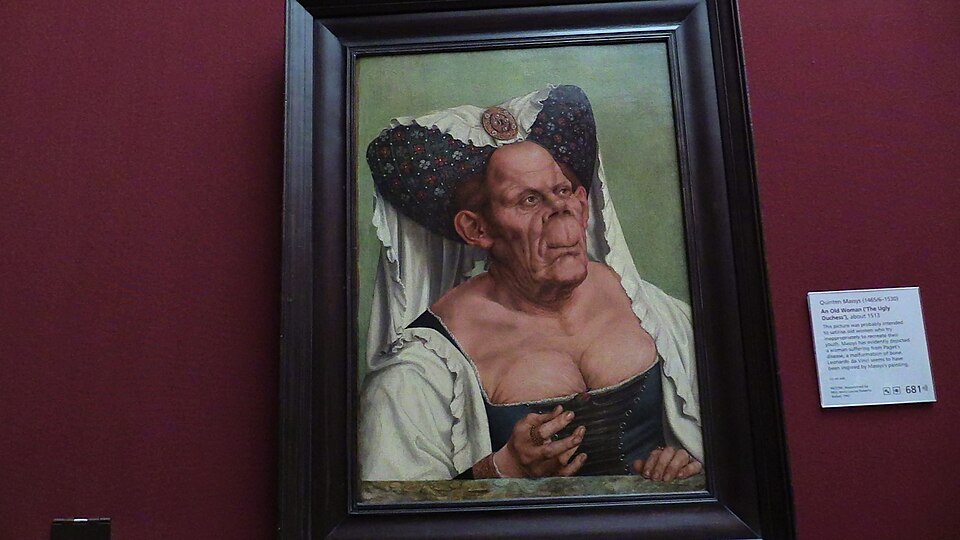
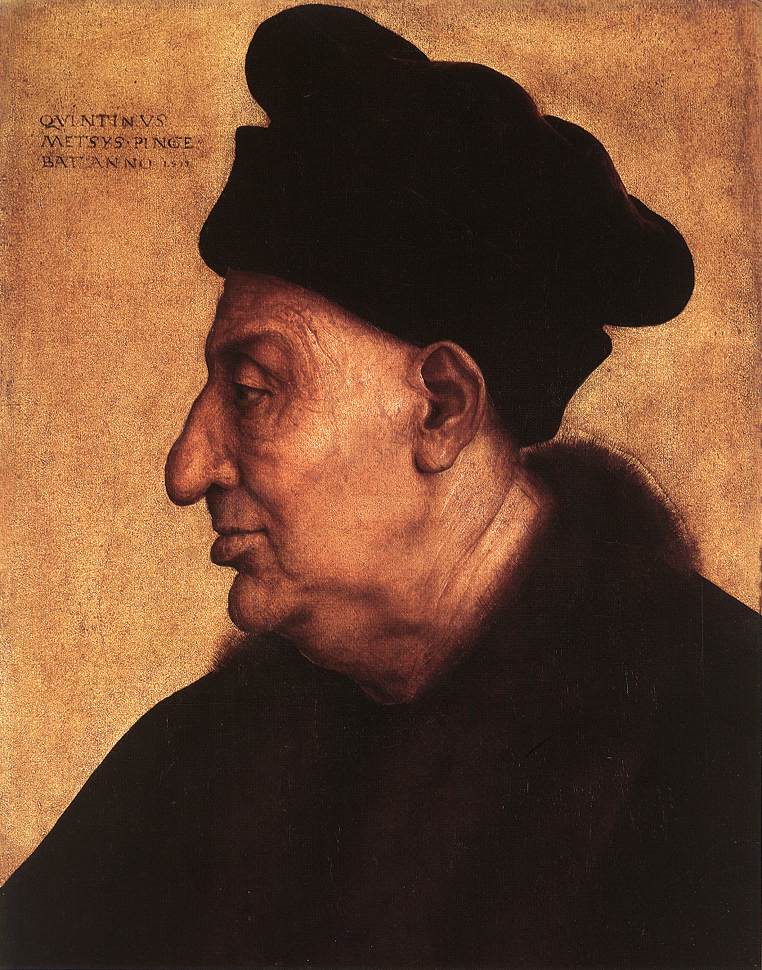
The Ugly Duchess is one of the most famous faces in the National Gallery in London: an elderly woman with a wrinkled, ape-like face, a low-cut dress and a horned headdress decades out of fashion. Fewer visitors know that she was painted with a partner. Her pendant, An Old Man, has spent the past half-century in a private collection in New York. On December 8 it will be offered at Christie’s in London with an estimate of £6 million to £8 million.
Both pictures are by Quinten Massys (also spelled Metsys or Matsys), the leading painter in Antwerp in the early 16th century, and both date from about 1513 to 1519.
Made from the same wood
The National Gallery’s published catalogue entry on The Ugly Duchess, whose formal title is An Old Woman, sets out how closely the two paintings belong together. The London panel measures 64.1 × 45.2 cm. An Old Man measures 64.3 × 45.8 cm, a difference that includes thin wood veneers added later. Both are made of two oak boards, and the gallery’s experts believe they were probably cut from the same planks.
The pair seem to have been split up before the end of the 17th century. Around 1645 the printmaker Wenceslaus Hollar made etchings after both, which suggests they were still together in Antwerp at that point. By the early 1700s An Old Man was in Normandy, in the collection of a councillor named Boisguiraud, and it later belonged to the comte de Saint-Priest in Évreux before resurfacing on the Paris art market in 1954.
The Ugly Duchess took a different route. It was probably sold in Paris in 1809, later belonged to the Seymour family in London, and was consigned to Christie’s in 1920, where it was bought by Hugh Blaker. His sister Jenny Blaker bequeathed it to the National Gallery, and it entered the collection in 1947.
Since then the two have been reunited only twice, both times in London: in the National Gallery’s Renaissance Faces exhibition in 2008 and in The Ugly Duchess: Beauty and Satire in the Renaissance in 2023.
Satire, not a medical case
For years, the Duchess’s exaggerated features fed a theory that Massys had painted a real woman suffering from Paget’s disease, a condition that deforms the bones. When the gallery staged its 2023 exhibition, it argued that she was more probably a fictional, folkloric figure of the kind found in carnival prints, a satire on vain old age dressing up as youth.
Her face and bust are also linked to Leonardo da Vinci. Two drawings reproduce a grotesque design by or after Leonardo, one in red chalk at Windsor attributed to his pupil Francesco Melzi, and one in black chalk at the New York Public Library. The gallery’s catalogue concludes that Massys adapted the motif himself, expanding it into a full composition.
The painting had a remarkable afterlife. John Tenniel’s illustrations of the Duchess for the first edition of Alice’s Adventures in Wonderland in 1865 drew directly or indirectly on Massys’s picture, which was by then in a private house in London.
What the old man adds
Seen alone, An Old Man is a striking, caricatured profile of an elderly man. Seen beside his partner, the joke becomes clear: the two were made to face each other, a mismatched couple parodying the dignified marriage portraits that were fashionable at the time. Christie’s describes both works as satires of the conventions of contemporary portrait painting.
The sale gives the National Gallery, or another museum, a rare chance to acquire the missing half of one of its best-known pictures. Whether that happens will depend on December 8, and on whether £8 million turns out to be enough.
The full history of both panels is set out in the National Gallery’s catalogue entry.