


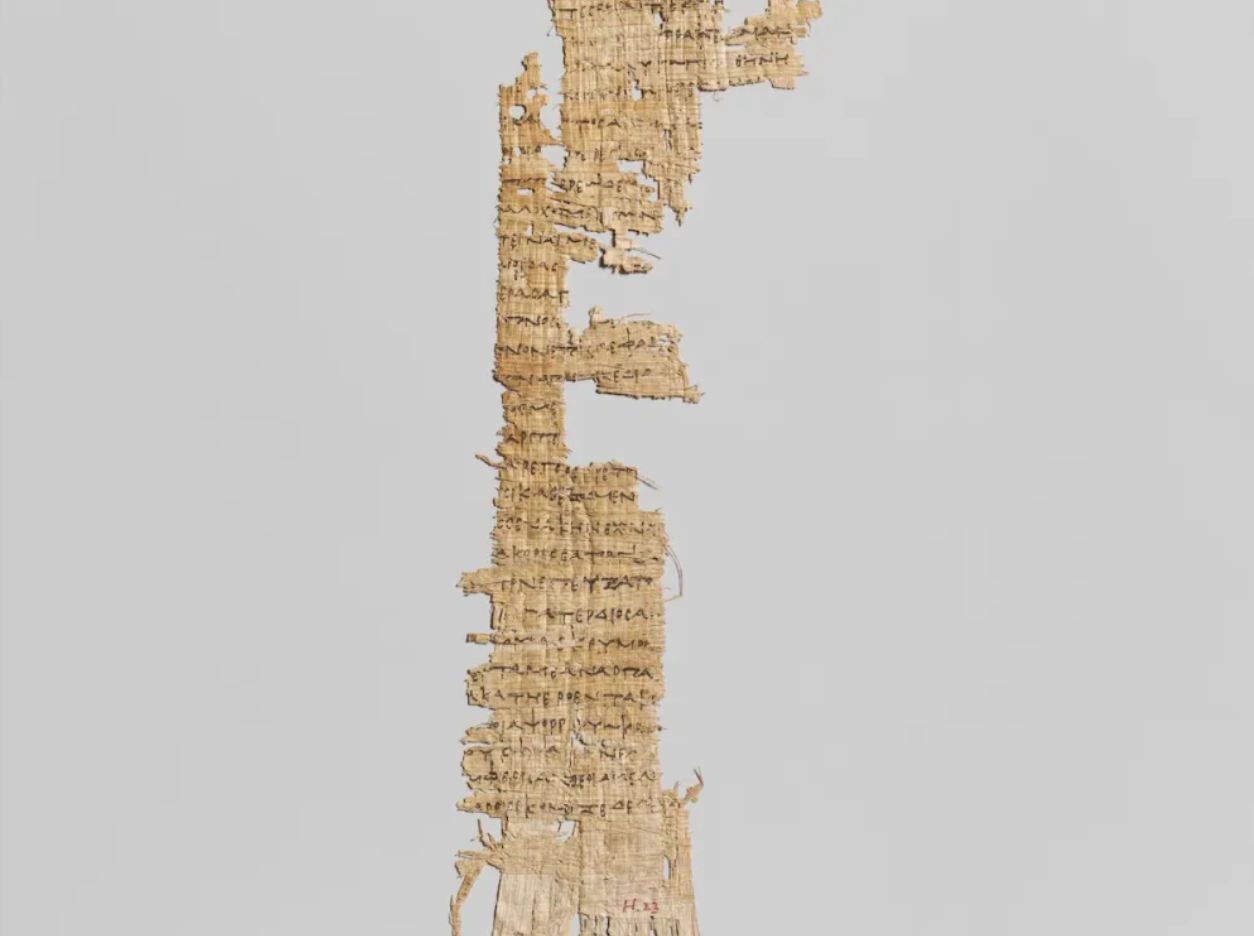
The oldest surviving fragments of Homer’s The Odyssey are now on display at the Metropolitan Museum of Art.
Homer’s epic has been back in the cultural zeitgeist ever since Christopher Nolan’s project became a box office hit. Now, The Met has decided to bring some history into pop culture and created a round-up of a range of artifacts related to the epic. The most important and impressive one, undoubtedly, is the oldest fragments of The Odyssey. The caption describes it as: “Dating from around 285–250 BCE and made in Egypt, this fragment is beautifully inscribed using a combination of charcoal and water via a stylus on papyrus—one of the most popular materials for writing in antiquity—and contains three lines that do not exist in today’s standard text.”
Also Read: Finest Japanese Prints Collection Heading To Christie’s
The fragment belongs to the early Ptolemaic era. Notably, the deciphered lines in the fragments differ slightly from the version of the epic known to us today. Sean Hemingway, curator of Greco-Roman art at The Met, attributes these variations to the oral nature of the original epic, which was often embellished and modified by certain bards who composed it in their own way. The round-up further added: “Like the Greek warrior, this object reminds us that the telling of The Odyssey itself has taken its own distinct journey through history.” The fragments are displayed in Gallery 162 in the Greco-Roman section of the Metropolitan Museum of Art.
