


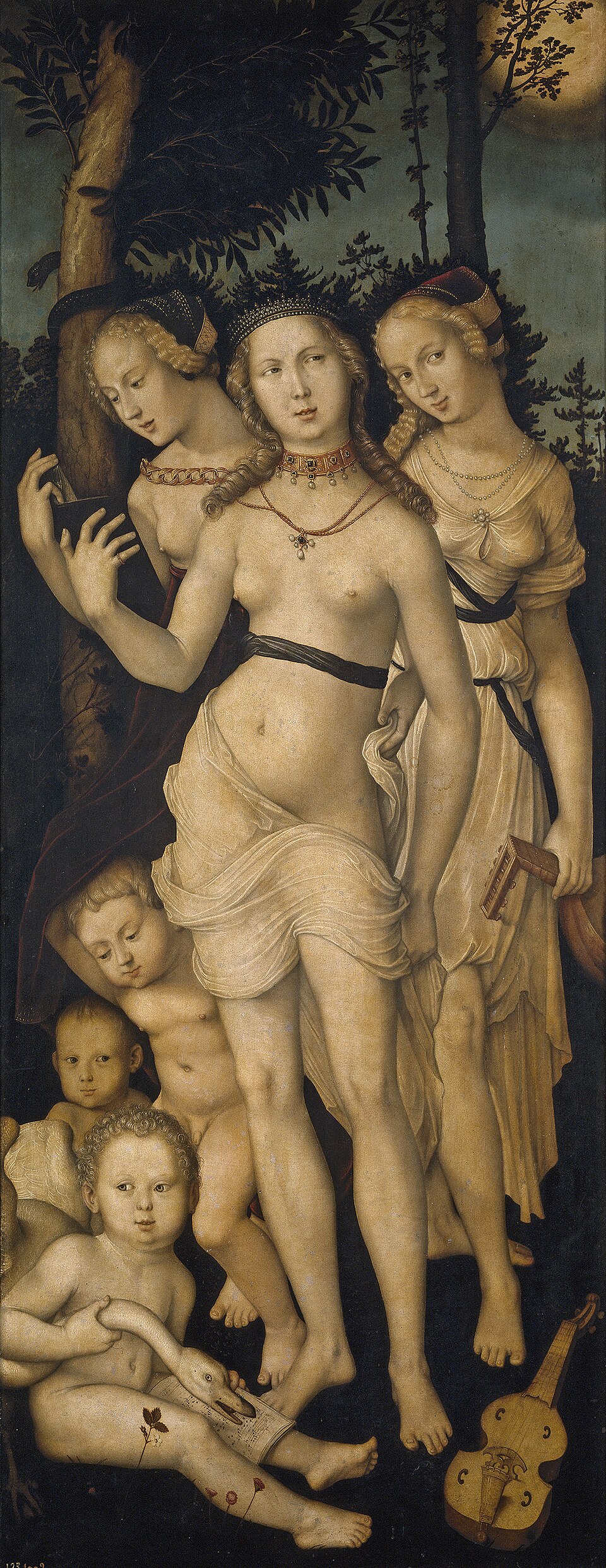
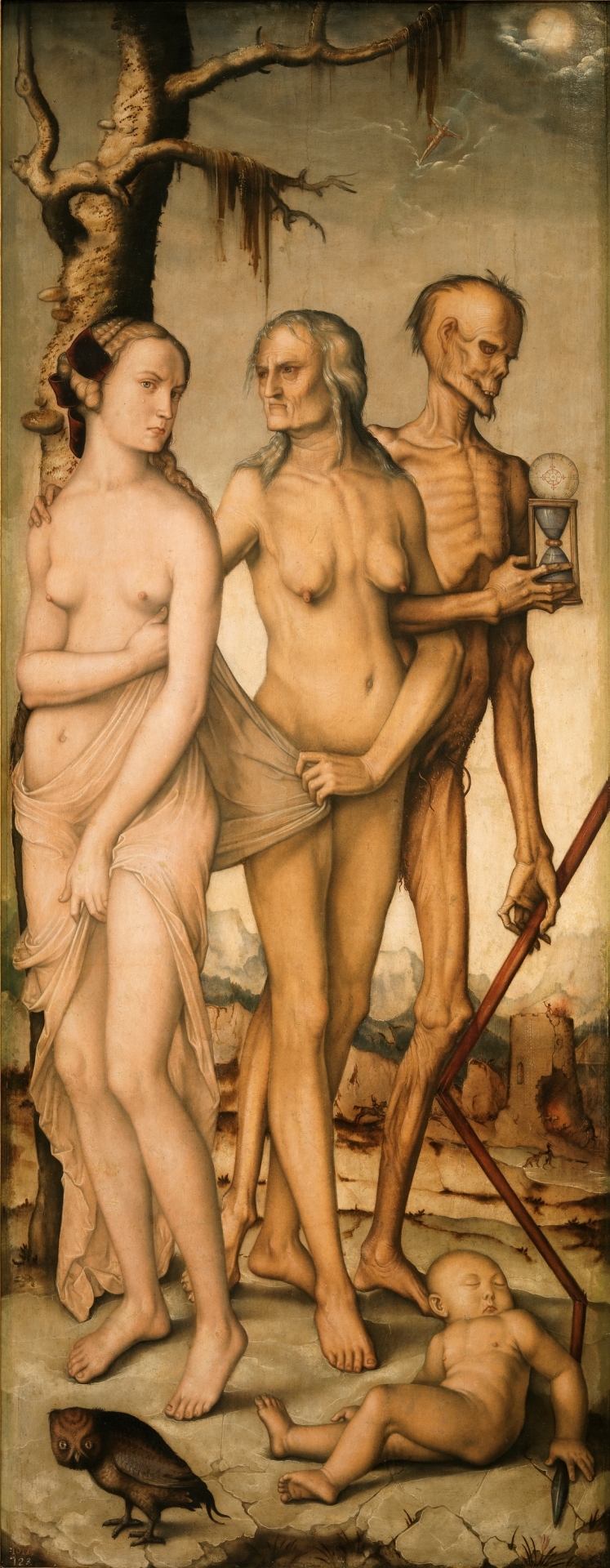
For more than four centuries, two tall, narrow panels by the German painter Hans Baldung Grien have been treated as a pair. One celebrates youth and beauty, with three graceful young women in an idyllic setting. The other shows the stages of life, from infancy to old age, being led away by Death in a bleak landscape. Now, after a recent restoration, the Museo del Prado in Madrid has built a small exhibition around them, the first in Spain devoted to the artist.
The show was presented to the press on November 20 and runs until March 7, 2027. Madrid’s official tourism office lists it in Room D of the Prado’s Jerónimos Building, open to the public from November 24, with admission included in the museum’s general ticket of €15.
Two paintings, two visions of life
The panels are Harmony (The Three Graces?) and The Ages and Death, both painted around 1541 to 1544 on linden wood and each measuring 151 by 61 centimetres. They are among the last paintings Baldung made before his death in Strasbourg in 1545.
They have a distinguished history. The panels first belonged to a Hessian count allied with the Schmalkaldic League of Protestant princes, then passed to a commander of Emperor Charles V’s troops after Frankfurt surrendered in 1547. By 1600 they were documented in the Alcázar, the royal palace in Madrid. Speaking at the presentation, the exhibition’s curator, Christine Seidel, said that the inventory of Philip II, made after his death, shows they were already hinged together as a diptych in the 16th century.
What the restoration revealed
The restoration changed how the pair looks together. It recovered a clear difference in colour between the two panels, which had always been considered a matching set. In The Ages and Death, the skin of the figures takes on reddish-brown tones that deepen as they grow older. “This chromatic contrast we saw was a little surprising,” Seidel told reporters, calling the exhibition “a great opportunity to understand the artist better.”
Infrared reflectography, a technique that looks beneath the paint layer, also showed that Baldung drew his compositions directly on the panel in a dry medium, probably black chalk, before he began to paint. A section of the exhibition is devoted to these technical findings.
Fifteen works, one obsession
Baldung trained in Albrecht Dürer’s workshop in Nuremberg and went on to become one of the most original artists of the German Renaissance, known for an unsettling mix of sensuality and death that still feels modern. The Prado show gathers 15 works, including paintings, drawings, prints and sculpture, to explore those themes.
The loans include The Seven Ages of Woman (1544) from the Museum der bildenden Künste in Leipzig, another Three Ages of Woman and Death from the Musée des Beaux-Arts in Rennes, Death and the Maiden from the Kunstmuseum Basel, Adam and Eve from Madrid’s own Museo Nacional Thyssen-Bornemisza, and a memento mori figure of Death from Salamanca Cathedral. Lucas Cranach the Elder’s The Judgment of Paris, lent by the Staatliche Kunsthalle Karlsruhe, places Baldung beside a contemporary he knew.
The show also includes the so-called Karlsruhe Sketchbook, a collection of more than 100 silverpoint drawings Baldung made in Strasbourg between 1511 and 1545. Some of its pages have been linked to the two Madrid panels and to the Leipzig painting, offering a rare glimpse of how his ideas developed.
A small show with a big collection behind it
The exhibition is part of the Prado’s effort to look more closely at the great masters of the Western tradition in its collection. The museum’s director, Miguel Falomir, said at the presentation that the Prado’s German paintings are probably the collection with the highest average quality in the museum. With only two Baldung paintings in the Prado’s collection, the show cannot be a full retrospective. What it offers instead is a chance to see two late masterpieces at their best, surrounded by works that explain them.
Opening hours and ticket details are listed by Madrid’s tourism office.