

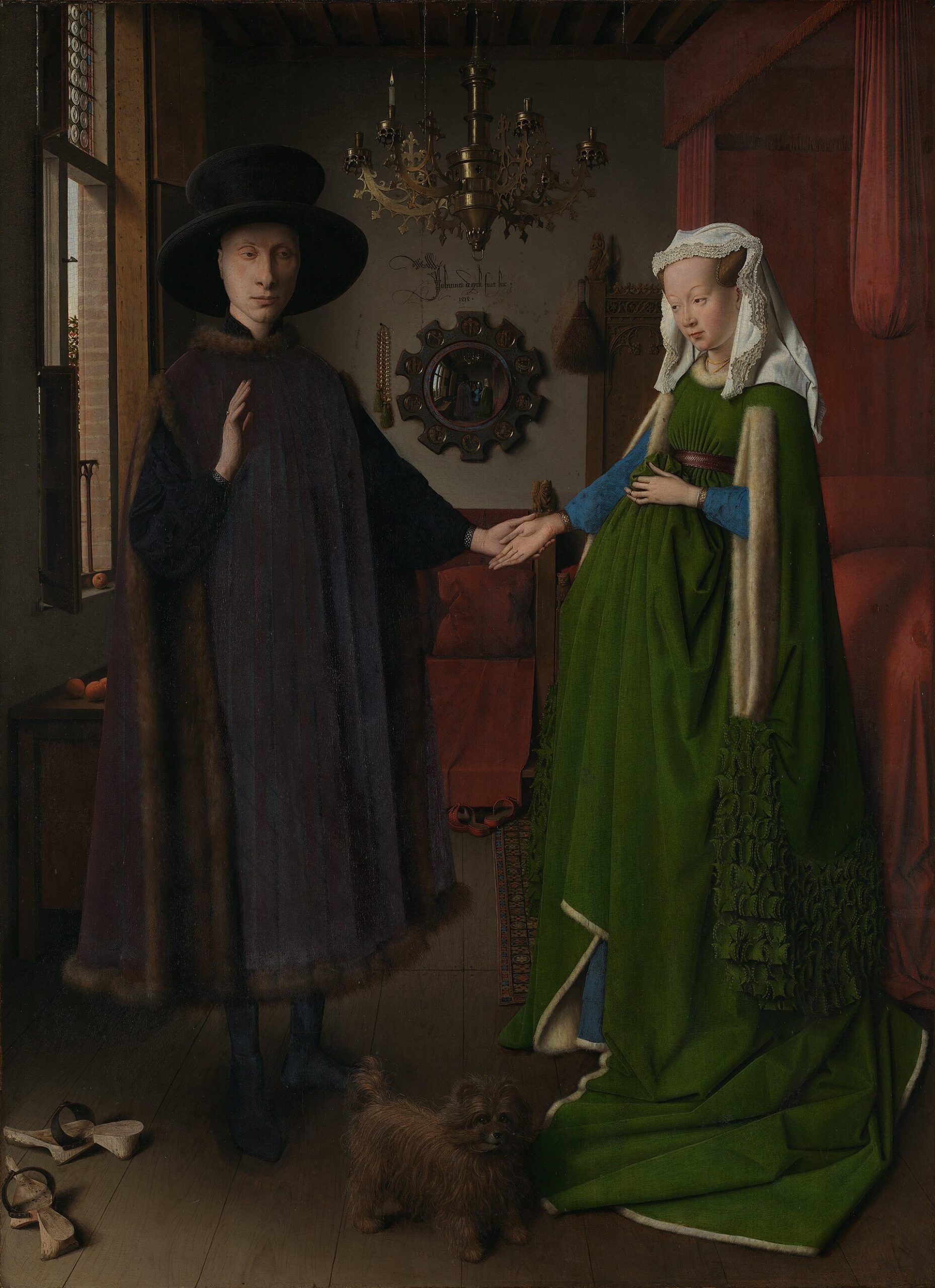
For more than 150 years, the couple in Jan van Eyck’s Arnolfini Portrait have been known as members of the Arnolfini family, Italian merchants from Lucca who did business in Bruges. Now a leading specialist in early Netherlandish painting has argued that they are nobody of the sort. The man, he says, is Van Eyck himself, and the woman is his wife, Margaret.
The theory comes from Stephan Kemperdick, curator of German, Netherlandish and French paintings before 1600 at the Gemäldegalerie in Berlin. He has presented it in recent talks, and sets it out in print for the first time in an essay for the catalogue of Van Eyck: The Portraits, the National Gallery’s exhibition opening in London on November 21.
The case for a self-portrait
Kemperdick’s argument starts with the most famous inscription in the painting, the Latin words on the back wall above the mirror, usually translated as “Jan van Eyck was here, 1434.” He points out that it is unusually large and that it places the artist’s name right beside the man’s head, which he reads as a deliberate link between the painter and the figure below.
He also questions the documentary evidence for the Arnolfini identification. The name comes from a 16th-century inventory entry describing the picture as showing “hernoul le fin.” In the early 1860s the scholar W. H. James Weale read this as a French form of Arnolfini, and the label has stuck ever since. Kemperdick argues instead that it was a later, mocking nickname, meaning something like a “deceived cheat,” and that in the early modern period the painting was classed as a lewd genre scene rather than a portrait.
Finally, there is the woman. A carved figure on the bedstead beside her head has been identified as St Margaret, which Kemperdick takes as a pointer to her name: Margaret van Eyck.
Not a new idea
The suggestion has a long history. In the late 1840s Charles Eastlake, who would become the National Gallery’s first director, read the inscription as “Jan van Eyck was this one,” and proposed that the picture was a double portrait of the artist and his wife.
Even within the Arnolfini theory, scholars have never agreed on which Arnolfini is shown. One candidate, Giovanni di Arrigo Arnolfini, appears to have been unmarried when the picture was painted. The other, his cousin Giovanni di Nicolao Arnolfini, had lost his wife before then.
The sceptics
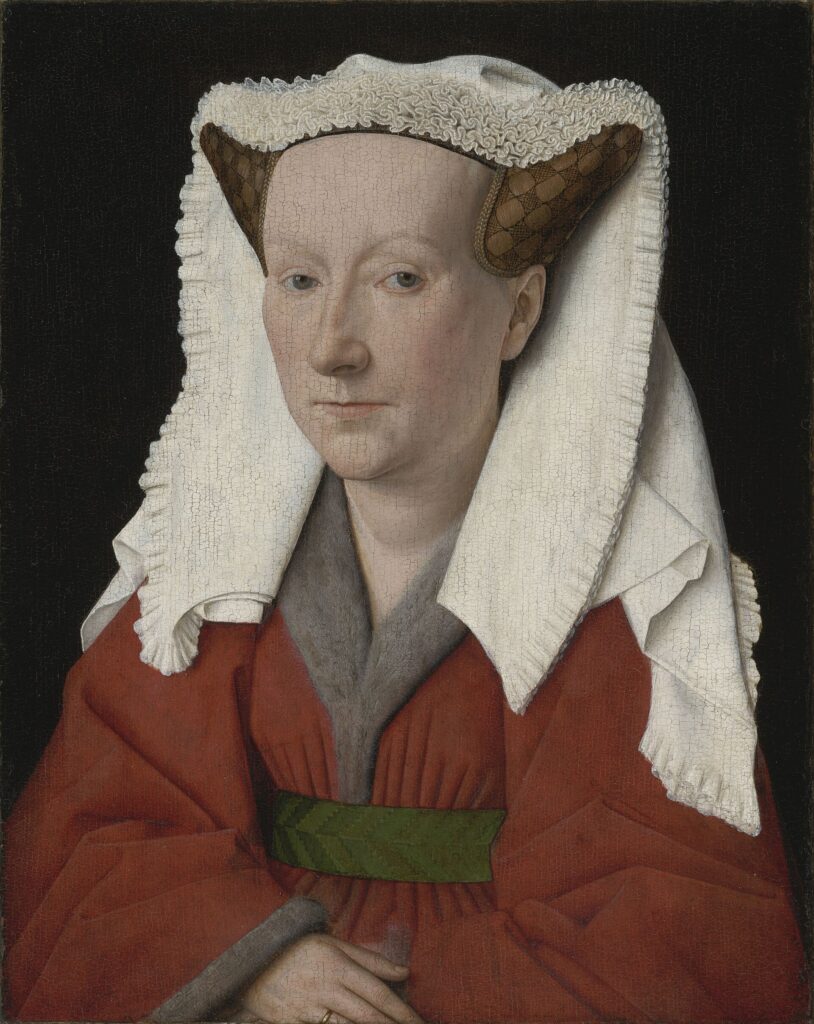
Not everyone is convinced. Nicholas Flory, who has co-curated the exhibition with the National Gallery’s Emma Capron, calls the theory interesting but speculative, and notes one awkward detail: Margaret has greyish-blue eyes in her 1439 portrait, while the woman in the Arnolfini Portrait has brown eyes.
Till-Holger Borchert, director of the Suermondt-Ludwig-Museum in Aachen and former director of Musea Brugge, says he is not entirely sure he can concur, and regards the inventory reference, linked to the collection of Margaret of Austria, as close to iron-clad evidence for the Arnolfinis. Maximiliaan Martens of Ghent University also sees no reason to doubt that the inventory refers to the family.
Why it matters
If Kemperdick is right, the consequences ripple through Van Eyck’s work. The National Gallery’s 1433 Portrait of a Man, the famous image of a man in a red headdress, is tentatively identified as a self-portrait. That could not be true if the man in the Arnolfini Portrait is the artist, because they are clearly not the same person.
The same man from the Arnolfini Portrait also appears in a separate small portrait in Berlin, painted around 1435 to 1438. Under Kemperdick’s guidance, the Gemäldegalerie has already dropped the Arnolfini name from it, calling it Portrait of a Man with a Red Chaperon.
The experts are divided on other old questions too, including whether the woman is pregnant or simply gathering up her heavy skirts, and whether the room is real or imagined.
See them side by side
Visitors will be able to judge for themselves. Van Eyck: The Portraits brings together all of the artist’s surviving portraits, including the 1439 portrait of Margaret lent from Bruges, and shows the Arnolfini Portrait beside the Berlin panel of the same man for the first time. The National Gallery itself labels the sitter “Giovanni(?) Arnolfini,” question mark included. The exhibition runs from November 21, 2026 to April 11, 2027.
The new theory was first reported by The Art Newspaper.