

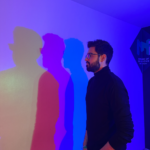

Yidi Wang (b. 1999) is a Chicago-based artist whose practice has moved from interactive design into multidisciplinary, multimedia performance and installation. She holds an MFA in Design for Emerging Technologies from the School of the Art Institute of Chicago. Across her work, Wang returns to questions of bodily autonomy, misogyny, gender roles, and posthumanism, often staging situations that combine poetic charge with clinical precision. She treats lived experience as material and renders intimate social expectations visible through systems, routines, and carefully constructed forms.
Performance art is frequently sidelined in contemporary art discourse, yet it remains one of the mediums most capable of producing sustained, visceral affect. Wang has long worked within this capacity. In projects such as Post-Birth, she treats performance as a testing ground for examining how bodies are disciplined, how care is structured, and how “motherhood” is culturally authored. The result is work that deliberately blurs the boundaries between artistic gesture and laboratory procedure, to examine reproduction as an engineered, externalized process sustained under prolonged observation.
Project Overview
Wang’s best-known project, Post-Birth, began as a durational performance and later expanded into a larger multi-media installation. In its early form, she strapped a prosthetic, womb-like structure to her torso and staged an extended enactment of pregnancy. She introduced bacterial cultures cultivated from her own body (hair, skin, and nail samples) into the artificial chamber and treated that growth as the work’s central “gestation.” The piece presents gestation as a process that can be relocated, designed, and maintained through deliberate construction.

In the installation’s later version, the project was presented in four parts: the external uterus, the bacterial culture as “fetus,” the hair/skin/nail samples that generated this “fetus,” and a CRT monitor. The monitor screened video documentation of Wang’s “maternity,” meaning the extended period during which she carried the external uterus through daily life, making the apparatus visible and foregrounding the time-based labor required to sustain it.
Rethinking Motherhood as Process

Motherhood is often framed through a paradox: celebrated as a divine gift while simultaneously treated as a natural duty. Public conversations often fixate on outcomes (the child, the family, the social role) and treat the journey as secondary. Post-Birth centers the process, specifically the repetitive, embodied work through which maternity is performed, regulated, and learned.
By moving gestation outside the body, Wang transformed reproduction into something visible, engineered, and deliberately constructed. The performance unfolded through repeated, almost ritualistic actions associated with maternity: stretching routines, measured breathing, routine examinations, and methodical observation. These gestures functioned as a disciplined practice sustained over time. Through repetition and regulation, the work frames maternity as learned, managed, and enacted through routine.
Wang described the period in physical, concrete terms:
“The attachment I experienced during Post-Birth was real, but not in a sentimental or nurturing way. It was strange, invasive, and often uncomfortable. The bacteria were multiplying constantly, twenty-four hours a day, and because they came from my own body, they entered my life in a way that felt unavoidable. They did not feel like something I owned or chose; they felt like something that occupied me. I was carrying a resin ‘womb’ that I designed, which was physically heavy and worn on my body throughout the day, going to the studio, going to school, and moving through public space. The smell, the weight, and the responsibility gradually reshaped my daily behavior. I stopped going out socially and avoided situations where my presence might affect others. My life changed because they were there.”

Her account shows how the work frames “motherhood” as endurance and management, with daily life reorganized around an ongoing responsibility.
A Feminist Lens, Without Essentialism
At the center of Post-Birth lies an extended engagement with feminist thought, particularly its critique of motherhood as an automatic extension of female identity. Rather than presenting pregnancy as private emotion, Wang dissects it into observable behaviors (scheduled routines, regulated gestures, monitored actions) and in doing so exposes maternity as labor that is socially organized and expectation-driven.
The project also unsettles reproductive authority as something that belongs exclusively within fixed gender roles. By relocating gestation into an artificial device and extending care toward microorganisms, Wang loosens the conventional linkage between biology and identity. The work aligns with posthuman perspectives that understand kinship as relational rather than strictly genetic. Motherhood, here, is not destiny; it is a position shaped by systems of culture, power, and history.
Autobiography as Structure, Not Confession
Wang grounds her feminist orientation in lived conditions rather than abstract theory. Growing up in an Asian household, she became attuned to subtle but pervasive patriarchal pressures. Although never explicitly stated, she describes sensing a deficit tied to not being a son. Her father’s care coexisted with emotional distance, complicated by intermittent absence. Her mother, more tightly bound to patriarchal norms, attempted to reproduce those expectations in Wang’s upbringing.
These experiences informed Wang’s critique of gendered labor: women tasked with emotional work and nurturing, men expected to provide while remaining emotionally distant. The work treats personal history as structural evidence, not a one-directional accusation. She refuses to place blame solely on her mother, framing her instead as another subject shaped by systemic misogyny, and turns her critique toward the larger structures that distribute responsibility and authority. The work leaves these tensions intact and pushes the viewer toward introspection.
Toward a Posthuman Horizon
While Post-Birth began as a response to misogyny and widespread anti-abortion sentiments, Wang argues that gender is only one boundary among others. Much discourse around motherhood remains human-centric, where “mother” evokes a single normative figure, namely the caring, selfless woman. This frame obscures the fact that motherhood, in varied forms, is a fundamental condition across many living species.
With the bacterial culture occupying her constructed “womb,” Wang arrived at a different proposition: motherhood may not be tethered to species alone. The project opens a speculative horizon in which non-human life is treated as a peer within a shared ecology of care. The work uses reproduction as a conceptual lever, an unsettling, intimate entry point into imagining rights, kinship, and responsibility beyond human exceptionalism.
Other Projects and Exhibitions
Wang has produced other performance-based projects that continue to engage bodily autonomy, misogyny, gender roles, and posthumanism. JIWA (2021) addresses a generation of Chinese children shaped by intense familial pressure to excel. Blueprint and Imprint function as related works to Post-Birth, extending its inquiry into reproduction and motherhood.
Her work has been shown at the Chinese American Museum of Chicago, Mana Contemporary, the Barbara Galeta Contemporary Art Foundation in Barcelona, EEA Gallery in New York, No Nation Tangential and Space Lab, and the Carolyn S. Mark Gallery in Wisconsin.