


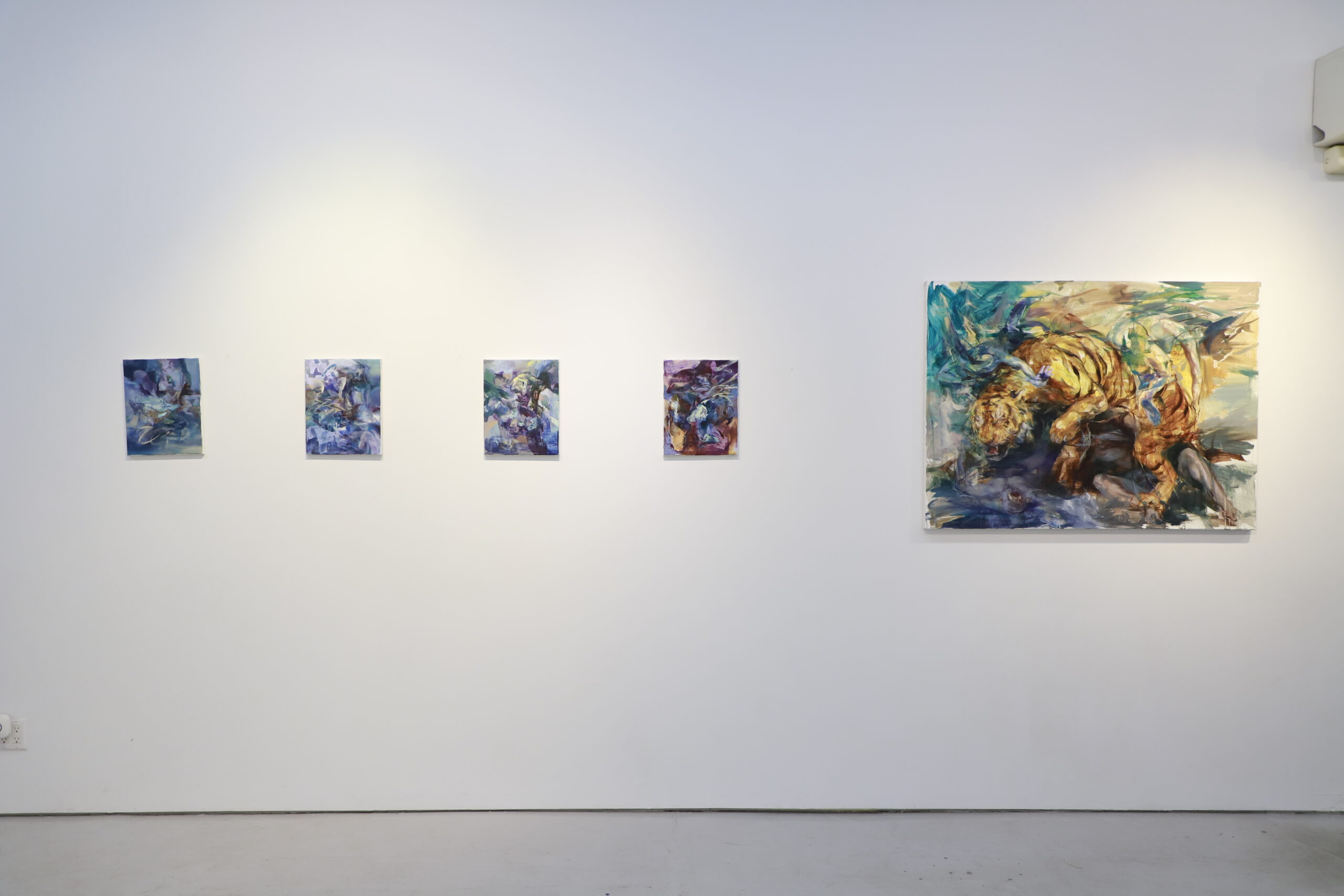
Ruoyu Gong’s solo exhibition Long Way Around presents itself as an assertion of painting’s renewed urgency. Shown at Eli Klein Gallery and curated by Huan Yang, the presentation marks Gong’s return to oil painting after years of expansive material experiments. Yang frames the exhibition as a timeline of milestones leading to the artist’s current visual expression, positioning earlier experiments not as deviations but as necessary stages within an evolving language. This return operates as consolidation: a gathering of prior detours—bas-relief, monotype, collage—into a more distilled and psychologically charged painterly approach.
At first encounter, the works oscillate between recognizable forms and abstraction. Gong constructs space not through rigid perspective but through shifts in tones, temperature, and varied mark-making. Forms breathe in and out of legibility, producing a rhythm that insists on prolonged looking. These works resist immediacy. Instead, they reward patience, offering perception as a gradual recalibration.
This evolution becomes especially clear in Your Wish Is My Command, rendered in luminous blue and yellow. Gong stages an ambiguous crossing. Two donkeys occupy a narrow boat drifting across a glassy body of water; behind them, a fractured architectural beam pierces the sky, while a small house perches at the horizon’s edge. The composition splits vertically, as though reality itself were hinged.
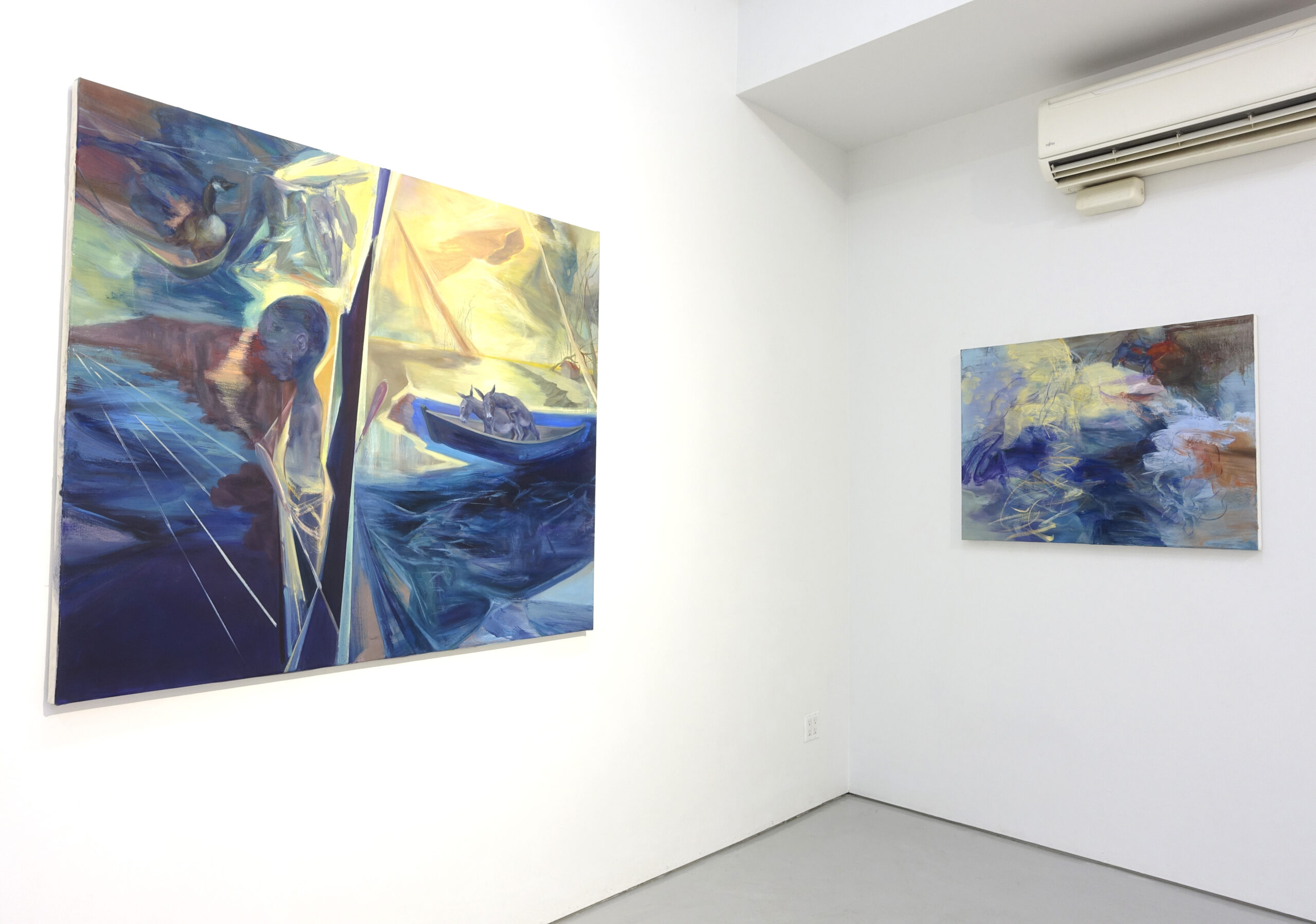
The title introduces irony, a kind of servitude implied within a scene of suspended stillness. Yet nothing feels literal. The animals neither strain nor rest; they hover in an unresolved interval. Here, Gong’s brushwork becomes remarkably atmospheric: thin veils of translucency countered by sudden opacities, depth constructed through tonal recession rather than fixed geometry.
Where earlier works foregrounded tactile assertion—collaged elements, three dimensional reliefs, and found objects—Long Way Around internalizes sculptural tension. Spatial friction is achieved through layered glazes, surface interruptions, and subtle distortions of scale. The physicality of past experimentation remains, but it is absorbed into pigment.
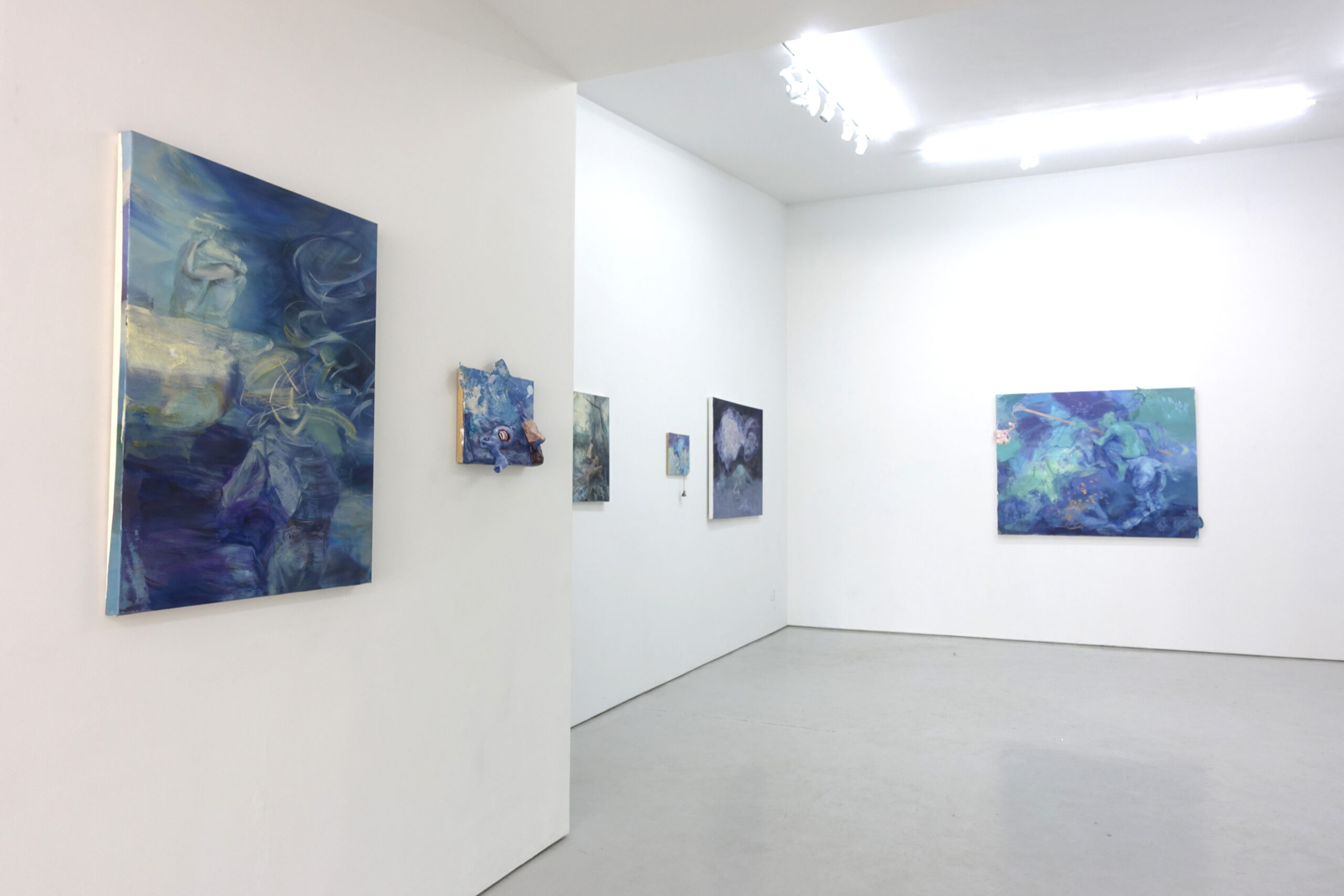
Humor, long central to Gong’s practice and informed by traditional Chinese comedy Xiangsheng, undergoes refinement. Rather than delivering punchlines, humor now manifests as deliberate irony. A solemn landscape carries an undercurrent of absurd devotion; a donkey in quiet suspension evokes both dignity and futility. Yang’s curatorial focus on cross-cultural dialogue and psychological tension underscores this dimension, highlighting how humor and instability function not as decoration but as structural strategies within the paintings.
The exhibition’s title proves apt. Long Way Around suggests delay, detour, and resistance to linear arrival. Gong’s compositions mirror this philosophy. Brushwork accumulates without forcing resolution; spatial cues open pathways only to redirect them. Meaning emerges as negotiation rather than declaration. In an art climate often driven by immediacy, Gong’s embrace of circuitous development feels reassuring.
Subtly embedded throughout is Gong’s engagement with his Chinese cultural memory. References to Chinese visual and symbolic vocabularies surface not as illustrative emblems but as tonal echoes—fragments dissolved into painterly structure. Rather than staging identity through overt signifiers, Gong articulates hybridity through atmosphere and ambiguity. East and West, figuration and abstraction, irony and earnestness coexist without hierarchy.
What distinguishes Long Way Around is its refusal of categorical clarity. The works inhabit thresholds: between narrative and abstraction, melancholy and wit, corporeality and dissolution. This sustained ambiguity opens a space in which tension softens into empathy. Gong’s return to oil painting does not mark a simplification but a deepening. In the broader contemporary field, Gong’s practice affirms painting’s continued capacity to engage psychological complexity. His canvases argue quietly but convincingly for painting as a medium of focused engagement.
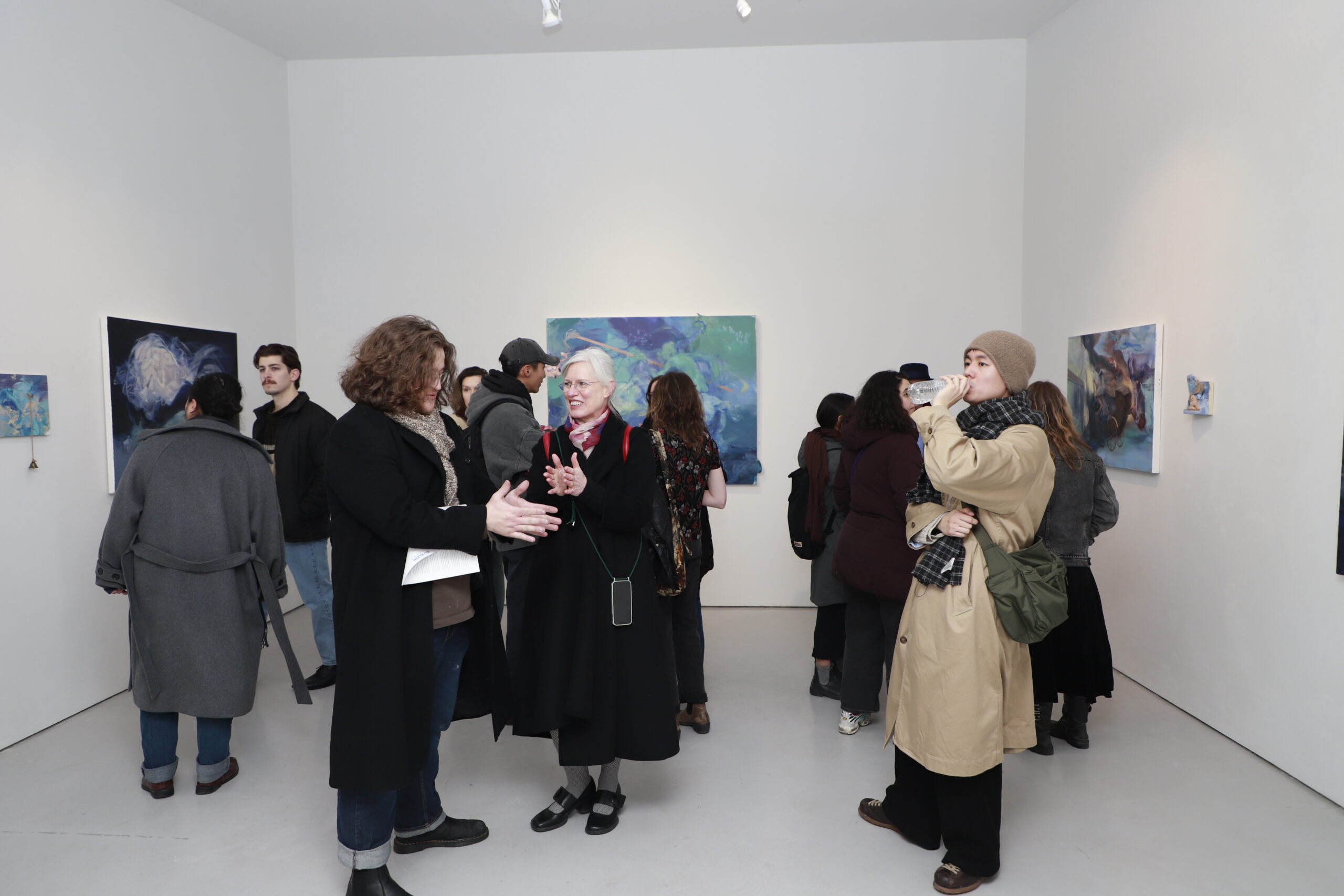
At twenty-six, Ruoyu Gong has established a trajectory marked by steady development and increasing clarity of vision. Born in Beijing in 1999 and now based in New York, Gong earned his MFA in Painting from the New York Academy of Art in 2025, where he received the Patron’s Scholar Award, following his honors BFA from the Rhode Island School of Design and advanced training at the Central Academy of Fine Arts. His work has been exhibited internationally, including at Focus Art Fair in New York and the Matalon Foundation in Milan, where he was awarded First Place in YICCA 23/24, as well as at a number of venues across New York. Featured in publications such as Harper’s Bazaar Art, Robb Report, and Modern Renaissance Magazine, Gong’s practice reflects a sustained engagement with the evolving language of contemporary painting.
Long Way Around marks the artist’s decisive refinement of his practice. Gong does not take the shortest path. He builds, revises, circles back. In doing so, he affirms the long way as the necessary way—where ambiguity becomes strength, and painting becomes a space where contradiction simply remains.
Photo Credit: Haidong Yang
