


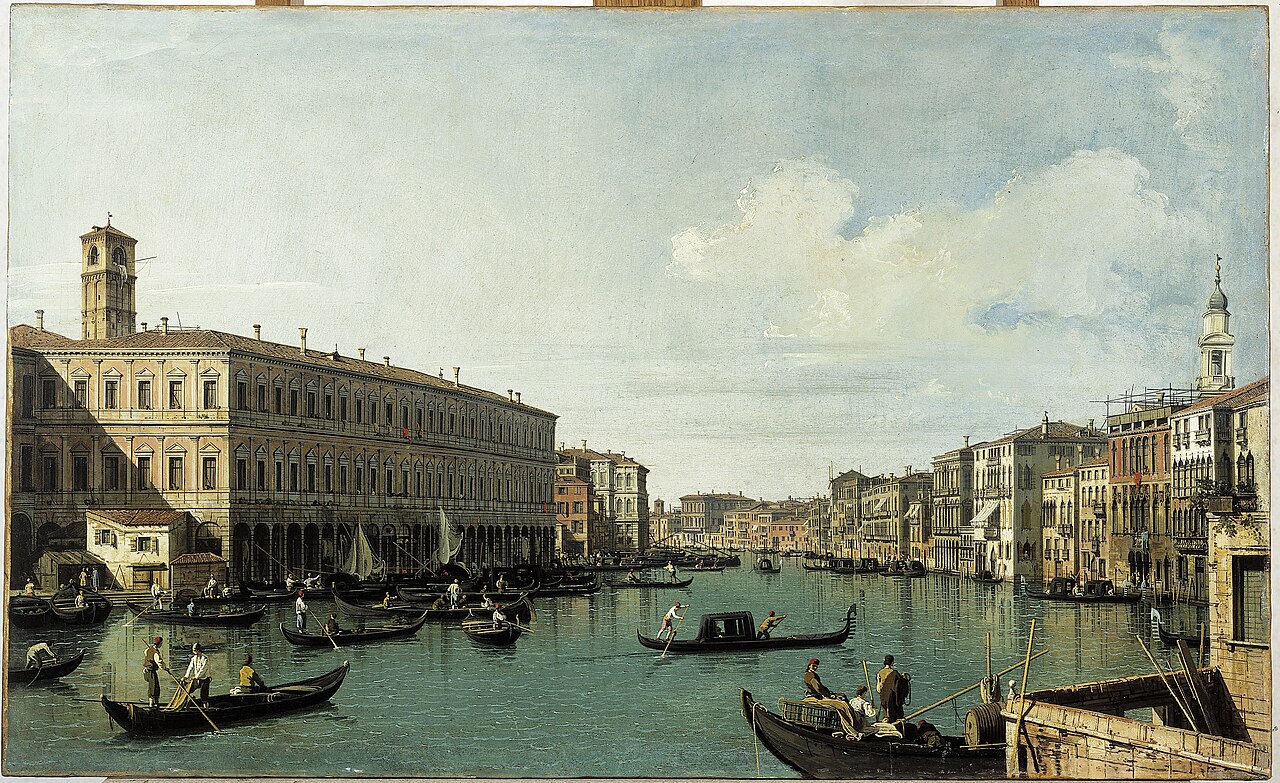
Canaletto painted the Grand Canal again and again, but he rarely signed his work. A newly rediscovered view of Venice is one of the exceptions. In the lower left corner it reads “Ant. Canal Fecit MDCCXLIV”, Antonio Canal made this, 1744. Largely unknown to scholars for almost three centuries, the painting has now entered the collection of Palazzo Maffei, a private museum in Verona.
A view from the middle of the canal
The painting’s full title is The Grand Canal Looking Southeast, from Palazzo Pesaro to the Fondaco dei Tedeschi. It is painted as if from a boat in the middle of the canal, with the great Baroque façade of Ca’ Pesaro in the foreground and the view running down towards the Rialto and the Fondaco dei Tedeschi, the old trading house of the German merchants.
The composition was not new for Canaletto. An earlier version, dated to around 1734, belongs to the Dukes of Bedford at Woburn Abbey, and sketches used for both paintings survive in the Cagnola Album at the Gallerie dell’Accademia in Venice. That makes the new picture a valuable comparison, showing how Canaletto returned to and refined a view a decade later.
How it was authenticated
The painting was not completely unknown. It appeared in 1975 in advertising pages placed by the Galleria Sacerdoti of Milan in the journal Arte Veneta, but it then dropped out of sight and was never properly studied. Its attribution has now been confirmed through infrared and ultraviolet examination, restoration by the conservator Carlotta Beccaria and research by Anna Bożena Kowalczyk, one of the leading specialists on Canaletto and his nephew Bernardo Bellotto.
Kowalczyk points to the way the buildings on the right bank are drawn in perspective, which she describes as characteristic of Canaletto since the late 1730s, as one of the features that confirm his hand.
Why 1744 matters
The date places the painting at an interesting moment. In the early 1740s Canaletto’s main market, the British aristocrats who bought views of Venice as souvenirs of the Grand Tour, was disrupted by the War of the Austrian Succession, which made travel to Italy more difficult. Within a few years, in 1746, he left for London, where he spent most of the next decade. A signed and dated Venetian view from just before that move is a useful fixed point in his chronology.
Signed Canalettos are rare, and the inscription, together with the painting’s documented technical study, will make it an important reference for scholars working on his output in the 1740s.
A new home in Verona
Palazzo Maffei, on Verona’s Piazza delle Erbe, houses the collection of the entrepreneur Luigi Carlon, whose interest made the acquisition possible. The museum mixes old master paintings with modern and contemporary art, and the Canaletto now joins its collection, a short train ride from the city it depicts.