

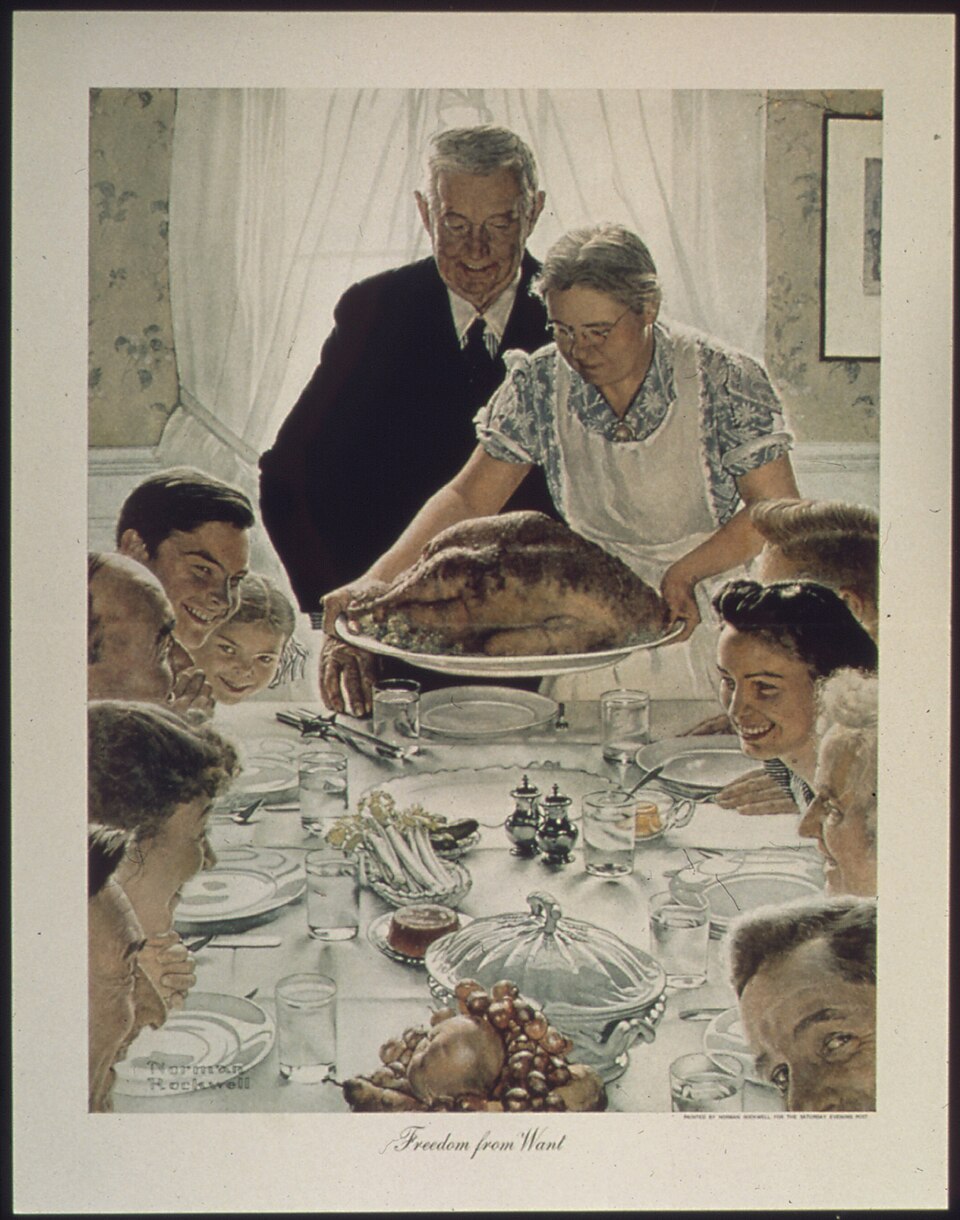
On Thanksgiving, one painting turns up more than any other: a grandmother setting down a huge roast turkey before a table of smiling relatives, while her husband stands ready to carve. Norman Rockwell’s Freedom from Want has been reproduced, parodied and pinned to fridges for more than 80 years. Yet the scene everyone thinks of as the perfect American family dinner shows people who were not a family at all, and who never sat at that table together.
A painting about a speech
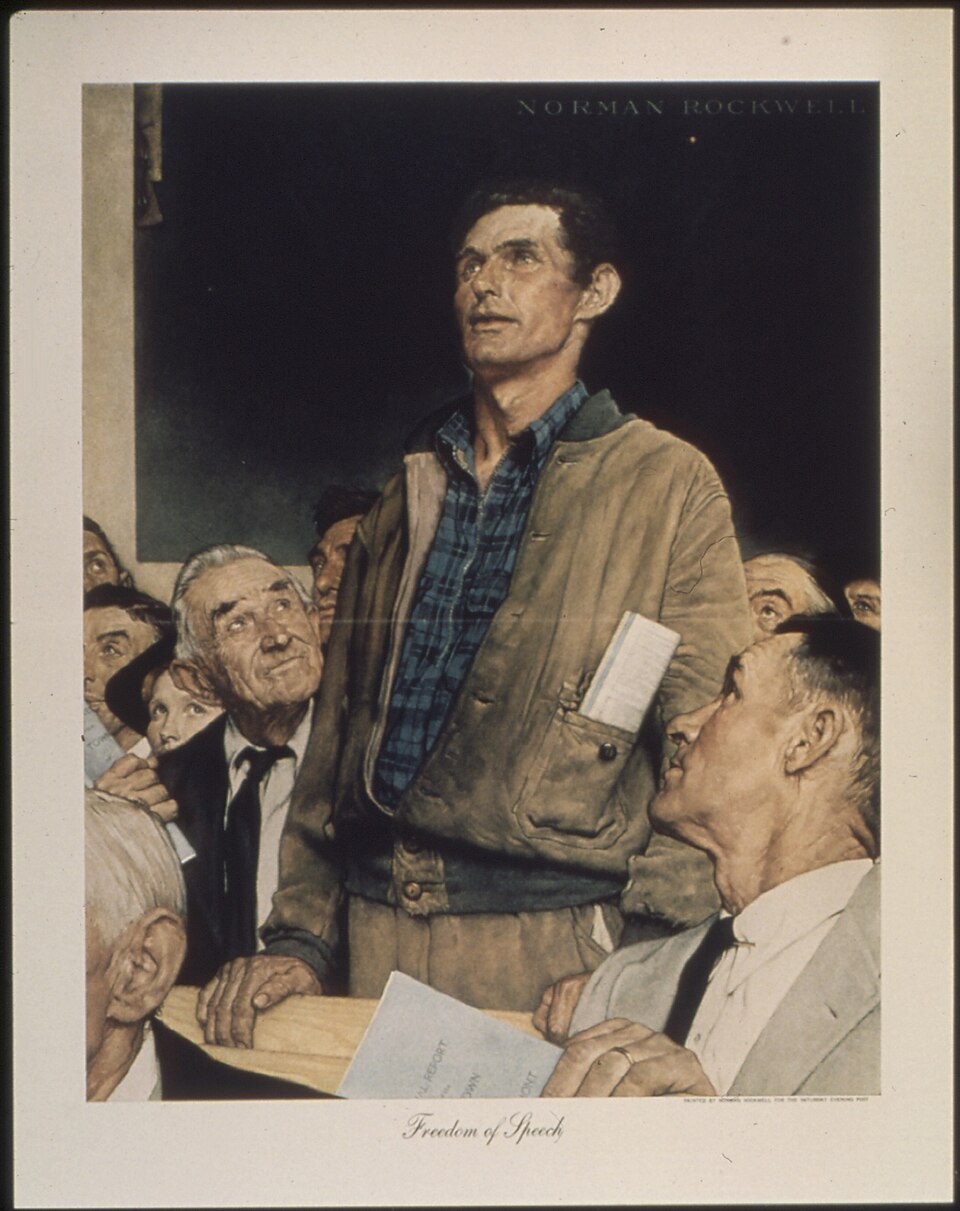
The picture began with politics, not turkey. In his State of the Union address in January 1941, President Franklin D. Roosevelt set out four freedoms that he argued every person should enjoy: freedom of speech, freedom of worship, freedom from want and freedom from fear. The idea made little impression on the public until the United States entered the Second World War at the end of that year.
Rockwell, already the best-known illustrator at The Saturday Evening Post, wanted to turn the four freedoms into pictures that ordinary Americans would understand. According to the Museum of Fine Arts, Houston, which staged a major exhibition of the series, he first offered the idea in 1942 to the War Department, which could not pay for it, and then to the Office of War Information, which turned him down. The Post’s new editor, Ben Hibbs, saw the sketches and told him: “Drop everything else. Just do the Four Freedoms.”
Rockwell was given eight weeks. The four paintings took him about seven months.
Who is really at the table
Rockwell lived in Arlington, Vermont, at the time, and like most of his work, the painting was built from neighbours, friends and family who posed for him in the studio. They were photographed and painted separately, then assembled into one scene.
- The grandmother serving the turkey was Mrs. Thaddeus Wheaton, the Rockwells’ cook. She also cooked the turkey used in the painting.
- Rockwell’s wife, Mary, appears among the guests on the left side of the table.
- His mother, Nancy Rockwell, is also among the diners.
- The man peering out of the lower right corner is Jim Martin, a neighbour who modelled for Rockwell many times.
Rockwell later joked about eating the turkey once the painting was done. He called Freedom from Want the easiest of the four to paint, and art historians often single out its technical bravura, with white plates on a white tablecloth, a challenge few illustrators would set themselves.
Not everyone loved it
Freedom from Want was published in the Post on March 6, 1943, alongside an essay by Carlos Bulosan, a Filipino immigrant writer and labour organiser, whose text described the hardship and violence faced by Asian immigrants on the West Coast. The pairing of Rockwell’s abundant table with Bulosan’s account of hunger has struck many readers since as an uneasy one.
Abroad, the painting went down badly. Rockwell later recalled that Europeans resented it, because what it showed was not freedom from want but “overabundance, the table was so loaded down with food.” For people living under rationing and occupation, it could look like a celebration of plenty they could not share.
The painting that sold war bonds
At home, the reaction was overwhelming, and the government, which had rejected Rockwell’s idea, now embraced it. The four paintings were sent on a national tour to sell war bonds, and the Office of War Information printed them as posters. The tour is widely reported to have raised more than $130 million for the war effort.
The originals now belong to the Norman Rockwell Museum in Stockbridge, Massachusetts.
Why it still works
Part of the painting’s staying power is that it captures a moment everyone recognises: the second before the meal begins, when the turkey arrives and the conversation has not stopped. The fact that its family was invented, put together from a cook, a neighbour, a wife and a mother, may be the most American thing about it. It shows the kind of gathering people chose, as much as the one they were born into.
The story of the series is told in more detail by the Museum of Fine Arts, Houston.